
Beside issues with Bell inequalities, there are more problems with such view, like Hardy's paradox: https://en.wikipedia.org/wiki/Hardy%27s_paradox
Here is a nice diagram from Pawel Blasiak slides ( https://www.dropbox.com/s/jd7fixmpbyqb6 ... 8PB%29.pdf ):

You need to choose A_a and B_b functions of hidden variable lambda, such that |11> on 'z' is forbidden, but all other possibilities have nonzero probability - how to do it?
Observe that this paradox does not work in time-symmetric view like TSVF ( https://en.wikipedia.org/wiki/Two-state ... _formalism ): e.g. hidden local variables can come from both time directions to provide required dependence on the choice of second measurement.
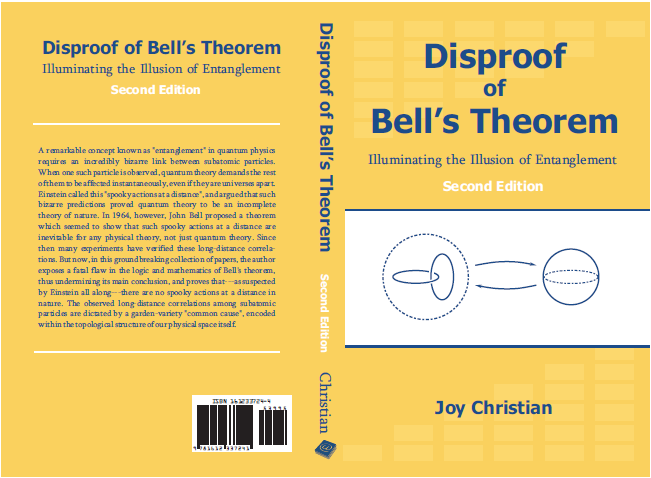
 It is clear that you haven't got the message of my replies above. Unfortunately, my local-realistic model is not everyone's cup of tea.