
Preliminary remarks:
The two-computer-files-challenge "the (still) open one-sided bet", http://www.sciphysicsforums.com/spfbb1/viewtopic.php?f=6&t=52, is still open, but the topic (started by me) is locked (at my request; thanks, Fred!), on the following grounds: Michel has convinced Christian that he can never win it (that's progress).
This means that the Christian experiment will also never be done, since a successful experimental outcome would mean a successful claim to the two-computer-files-challenge, but everyone now agrees that this is impossible. Hence the related topic (started by me) Joy Christian's colourful exploding balls experiment, http://www.sciphysicsforums.com/spfbb1/viewtopic.php?f=6&t=31, is now also locked (also at my request, with thanks again to our friendly forum admin).
People who still want to talk about these things can obviously start new topics on the forum.
Now for something not completely different. Please imagine the following experiment. It leads to what I would like to call "the mother of all quantum challenges"
A thought experiment:
Alice and Bob are physics students. They are in different classrooms and in each classroom there is a black box, called "measuring device A" and "measuring device B" respectively. These two boxes are connected to another black box in another classroom, called "source", through some kind of cables, tunnels, or whatever, so that all three black boxes have means to share any information they like. Alice and Bob's boxes each have two buttons, and two lights. The buttons can be pressed, the lights may or may not flash. The communication channels can be switched on and off.
Initially the communication channels are open, and probably being used too...
The following is now repeated 10 000 times:
Step 1. The connections are severed.
Step 2. Alice presses the button marked "0" or the button marked "90"; Bob presses the button marked "45" or the button marked "135". After Alice and Bob have each pressed a button, a red or a green light flashes on their box. They record their input and their output.
Step 3. The connections between the three magic black boxes are restored.
Assume that in each of the 10 000 runs or trials, Alice and Bob each independently choose their button completely at random. Imagine that we get to see the following statistics, each of course based on a disjoint subset of about 2 500 runs:
Prob(lights flash same colour | "0", "45")
= Prob(lights flash same colour | "90", "45")
= Prob(lights flash same colour | "90", "135")
= 0.85
Prob(lights flash same colour | "0", "135")
= 0.15
The mother of all quantum challenges
Challenge to Michel (and anyone else who wants to make a big contribution to science): write three computer programs which simulate the three magic boxes, to be run on three separate computers sending one another messages by internet (to simulate the communication channels).
Fine by me if you just write one computer program but it must be clear that it could be broken into separate pieces as required.
The first person who succeeds will almost certainly win the Nobel prize and revolutionarise quantum physics. And prove conclusively that quantum entanglement is a myth. You are welcome to program Joy Christian's S^3 based theory to achieve this aim. Why are we waiting? Which Bell-denier is going to be first? They can't even do this yet in the quantum optics lab, though they say they might get there in five years. Beat them to it, beat them at their own game!
The mother of all quantum challenges
46 posts
• Page 1 of 3 • 1, 2, 3
The mother of all quantum challenges
 by gill1109 » Sun May 11, 2014 12:54 am
Last edited by gill1109 on Sun May 11, 2014 1:02 am, edited 4 times in total.
- gill1109
- Mathematical Statistician
- Posts: 2812
- Joined: Tue Feb 04, 2014 10:39 pm
- Location: Leiden
Re: The mother of all quantum challenges
by gill1109 » Sun May 11, 2014 12:57 am
Note: for pedagogical purposes, I rewired the lights on the outside of Bob's box, switching the two colours of the lights relative to earlier versions of this story. Nothing was changed inside the box.
- gill1109
- Mathematical Statistician
- Posts: 2812
- Joined: Tue Feb 04, 2014 10:39 pm
- Location: Leiden
Re: The mother of all quantum challenges
by Joy Christian » Sun May 11, 2014 2:04 am
gill1109 wrote:The two-computer-files-challenge "the (still) open one-sided bet", http://www.sciphysicsforums.com/spfbb1/viewtopic.php?f=6&t=52, is still open, but the topic (started by me) is locked (at my request; thanks, Fred!), on the following grounds: Michel has convinced Christian that he can never win it (that's progress).
This means that the Christian experiment will also never be done, since a successful experimental outcome would mean a successful claim to the two-computer-files-challenge, but everyone now agrees that this is impossible. Hence the related topic (started by me) Joy Christian's colourful exploding balls experiment, http://www.sciphysicsforums.com/spfbb1/viewtopic.php?f=6&t=31, is now also locked (also at my request, with thanks again to our friendly forum admin).
What an absolute load of hogwash Richard Gill has conjured up?
In the light of his persistent but entirely baseless propaganda against my proposed experiment, let me make a list of evidence here in support of the experiment:
The readers of this forum have two options: (1) they can either believe the propaganda produced by Richard Gill, or (2) they can evaluate the evidence after evidence, and explanation after explanation, I have presented in support of my discovery that EPR-Bohm correlations are correlations among the points of a parallelized 3-sphere (which is one of the solutions of Einstein's field equations, namely the Friedmann-Robertson-Walker solution). The choice is theirs.
Let me present my evidence once again:
(1) A simple explanation of my proposed experiment, with links to relevant papers.
(2) The proof that there indeed exist N vectors, s_k and -s_k, appearing in equation (16) of my first experimental paper: http://rpubs.com/jjc/16531.
(3) Detailed explanation of my local-realistic framework for the quantum correlations, presented in 15 papers and one of my books on the subject.
(4) A spectacular 2D simulation of my 3-sphere model for the EPR-Bohm correlation.
(5) The most accurate simulation of my 3-sphere model for the EPR-Bohm correlation.
And finally, a nice summary by Michel Fodje of how Richard Gill operates---it is quite revealing.
His present tactic of closing down relevant forum topics is to avoid paying up the 10,000 Euros he owes me for producing the N vectors in the item (2) above.
- Joy Christian
- Research Physicist
- Posts: 2793
- Joined: Wed Feb 05, 2014 4:49 am
- Location: Oxford, United Kingdom
Re: The mother of all quantum challenges
by minkwe » Sun May 11, 2014 5:24 am
gill1109 wrote:Preliminary remarks:
The two-computer-files-challenge "the (still) open one-sided bet", http://www.sciphysicsforums.com/spfbb1/viewtopic.php?f=6&t=52, is still open, but the topic (started by me) is locked (at my request; thanks, Fred!), on the following grounds: Michel has convinced Christian that he can never win it (that's progress).
I don't understand why Richard continues to misrepresent me. I did no such thing that he claims I did. Not only that, since all his CHSH arguments have now failed he resorts to even more nonsensical probability challenges.
One example: He doesn't say how he decides to group an event from Alice with an event from Bob into something he calls "both lights", an omission which makes his "probabilities" incompletely defined, and meaningless.
Richard also claims to have hidden my posts yet he can't stop mentioning my name in everything he writes.
- minkwe
- Posts: 1441
- Joined: Sat Feb 08, 2014 10:22 am
Re: The mother of all quantum challenges
by gill1109 » Sun May 11, 2014 6:16 am
I should have mentioned (but it should be obvious to those who know the literature) that after pressing one button and seeing one light and writing down their action and their observation in their logbooks, Alice and Bob can walk out of their classrooms and chat to one another, have a cup of coffee or whatever, before going back for the next run/round. Obviously, there are some timing / synchronization arrangements in place.
For instance: one measurement per hour, with "connect" taking place once every hour, on the hour, and "disconnect" taking place once every hour, on the half-hour.
Another scheme would be to use "event ready detectors" as in Chapters 13 and 16 of "Speakable and unspeakable".

EG there is some controller at the source who using a separate phone line calls Alice and Bob to say: next package is on the way, do your stuff. They do their stuff, and then wait for the next call.
For instance: one measurement per hour, with "connect" taking place once every hour, on the hour, and "disconnect" taking place once every hour, on the half-hour.
Another scheme would be to use "event ready detectors" as in Chapters 13 and 16 of "Speakable and unspeakable".
EG there is some controller at the source who using a separate phone line calls Alice and Bob to say: next package is on the way, do your stuff. They do their stuff, and then wait for the next call.
- gill1109
- Mathematical Statistician
- Posts: 2812
- Joined: Tue Feb 04, 2014 10:39 pm
- Location: Leiden
Re: The mother of all quantum challenges
by Heinera » Sun May 11, 2014 8:26 am
minkwe wrote:I don't understand why Richard continues to misrepresent me. I did no such thing that he claims I did. Not only that, since all his CHSH arguments have now failed he resorts to even more nonsensical probability challenges.
One example: He doesn't say how he decides to group an event from Alice with an event from Bob into something he calls "both lights", an omission which makes his "probabilities" incompletely defined, and meaningless.
For each button press "0" or "90", Alice records which button she pressed, and which light flashes. This results in a 2xN matrix.
Bob records his button presses "45" or "135", and which light flashes. He will also get a 2xN matrix.
After the N runs, the two matrices are concatenated into a 4xN matrix. This can now be split into 4 disjoint matrices based on the 4 possible combinations of {0, 90} and {45, 135}. For each of these 4 matrices, we count the number of rows where the two light flash recordings both have the same colour. The probabilities are defined as this number divided by the total number of rows in the respective matrix.
Nothing incomplete about that.
- Heinera
- Posts: 917
- Joined: Thu Feb 06, 2014 1:50 am
Re: The mother of all quantum challenges
by minkwe » Sun May 11, 2014 9:33 am
Heinera wrote:Nothing incomplete about that.
Clearly you do not understand any of the issues involved. Richard understood the issue I raised, as confirmed by his half-hearted attempt to rectify the oversight in his response:
minkwe wrote:One example: He doesn't say how he decides to group an event from Alice with an event from Bob into something he calls "both lights", an omission which makes his "probabilities" incompletely defined, and meaningless.
gill1109 wrote:I should have mentioned (but it should be obvious to those who know the literature) that after pressing one button and seeing one light and writing down their action and their observation in their logbooks, Alice and Bob can walk out of their classrooms and chat to one another, have a cup of coffee or whatever, before going back for the next run/round. Obviously, there are some timing / synchronization arrangements in place.
For instance: one measurement per hour, with "connect" taking place once every hour, on the hour, and "disconnect" taking place once every hour, on the half-hour.
An attempt which still demonstrates naivity, as it places the unphysical restriction that the lights on the boxes must light-up instantaneously after the buttons are pressed. The more we discuss the "non-challenge" the more silly it sounds and the more remote it gets from any relevance to EPRB experiments.
First the challenge is simply: "write three computer programs which simulate the three magic boxes, to be run on three separate computers sending one another messages by internet ", then when issues about the silly challenge are revealed he says, "Oh, I meant that you can only communicate once every hour", when problems with that are pointed out, he will say "Oh, I meant that the lights must light up instantaneously after the buttons are pressed", and when further problems are pointed out about that, he will say "Oh, the boxes are not allowed to remember which button was pressed last time", and after that the next excuse will be "Oh, even though I said the lights may or may not flash, you can not use the fact that the lights fail to flash sometimes", and after that, the excuse will be "But, your simulation does not pass the challenge because you must use these equations over here to calculate the probability for your data, not those equations over there which only I am allowed to use I calculate my own probabilities.", etc, etc.
It turns out what he really wants is for others to implement a nonsensical/physically naive algorithm erroneously attributed to non-locality/non-realism, so that if it fails the rigged challenge, he can continue to believe in the voodoo of "non-realism"/non-locality.
- minkwe
- Posts: 1441
- Joined: Sat Feb 08, 2014 10:22 am
Re: The mother of all quantum challenges
by gill1109 » Sun May 11, 2014 10:04 am
Heinera wrote:minkwe wrote:I don't understand why Richard continues to misrepresent me. I did no such thing that he claims I did. Not only that, since all his CHSH arguments have now failed he resorts to even more nonsensical probability challenges.
Michel doesn't realize that he caused Joy Christian to realize that the challenge which Christian and Gill had jointly formulated was unwinnable by Christian (pretty devious of Gill, it must be admitted). But I think that Michel still doesn't know what exactly that challenge was, and probably he hadn't read Christian's so called experimental papers either.
I had hoped that this little escapade (Christian actually believing he could win a nonsensical unwinnable no-probability challenge) would show Michel that his hero Christian is actually fallible. And even badly fallible, in simple matters of logic and arithmetic. Which makes one wonder, why anyone should trust him in matters of Hopf fibrations and geometric algebra.
No matter. "Speakable and unspeakable" chapters 13, 14, 16 and 24 are much more important to read, and a whole lot of fun to read. And one can learn a lot from them... In particular, one can learn why my new "nonsensical probability challenge" is not so nonsensical at all.
- gill1109
- Mathematical Statistician
- Posts: 2812
- Joined: Tue Feb 04, 2014 10:39 pm
- Location: Leiden
Re: The mother of all quantum challenges
by Joy Christian » Sun May 11, 2014 10:39 am
gill1109 wrote:blah, blah, blah...
LOL! Even my dog produces better music than this.
The actual fact is much simpler than how Richard Gill fantasizes it. The painful fact for him is that he owes me 10,000 euros for successfully producing the N vectors, s_k and -s_k, appearing in eq. (16) of my paper: http://rpubs.com/jjc/16531. His present shenanigans are simply tactics to avoid paying up the money he owes me.
- Joy Christian
- Research Physicist
- Posts: 2793
- Joined: Wed Feb 05, 2014 4:49 am
- Location: Oxford, United Kingdom
Re: The mother of all quantum challenges
by Ben6993 » Sun May 11, 2014 1:55 pm
Instead, say there are four separate simulation experiments: 1) a=0 & b=45; 2) a=90 & b=45; 3) a=90 & b=135; 4) a=0 & b=135. There are 2500 simulated measurements made of A and 2500 simulated measurements made of B in each of the four experiments.
A correlation is calculated between A and B outcomes for each experiment separately, with each correlation being based on 2500 pairs of measurements. These four correlations will not give an average, of their four absolute values, greater than 0.5.
If the pairs were not entangled, the average correlation could by chance reach 1.0, though very unlikely. (This corresponds, I think, to a CHSH of 4 in an 8xN table.)
Lifting the average correlation from 0.5 to 0.7, for entangled pairs in a simulation, seems to rely on zero outcomes, i.e. on particles not being measured or measurable. Well, it did in the early simulations. I assume the zero outcomes are still there in the more recent, best, simulations? Somewhere on these threads, Michel stated that there is no requirement for all measurements to be made in a real experiment. I wonder if the geometry precludes some particles from being measurable.
A correlation is calculated between A and B outcomes for each experiment separately, with each correlation being based on 2500 pairs of measurements. These four correlations will not give an average, of their four absolute values, greater than 0.5.
If the pairs were not entangled, the average correlation could by chance reach 1.0, though very unlikely. (This corresponds, I think, to a CHSH of 4 in an 8xN table.)
Lifting the average correlation from 0.5 to 0.7, for entangled pairs in a simulation, seems to rely on zero outcomes, i.e. on particles not being measured or measurable. Well, it did in the early simulations. I assume the zero outcomes are still there in the more recent, best, simulations? Somewhere on these threads, Michel stated that there is no requirement for all measurements to be made in a real experiment. I wonder if the geometry precludes some particles from being measurable.
- Ben6993
- Posts: 287
- Joined: Sun Feb 09, 2014 12:53 pm
Re: The mother of all quantum challenges
by gill1109 » Sun May 11, 2014 7:38 pm
Ben6993 wrote:Instead, say there are four separate simulation experiments: 1) a=0 & b=45; 2) a=90 & b=45; 3) a=90 & b=135; 4) a=0 & b=135. There are 2500 simulated measurements made of A and 2500 simulated measurements made of B in each of the four experiments.
A correlation is calculated between A and B outcomes for each experiment separately, with each correlation being based on 2500 pairs of measurements. These four correlations will not give an average, of their four absolute values, greater than 0.5.
If the pairs were not entangled, the average correlation could by chance reach 1.0, though very unlikely. (This corresponds, I think, to a CHSH of 4 in an 8xN table.)
Lifting the average correlation from 0.5 to 0.7, for entangled pairs in a simulation, seems to rely on zero outcomes, i.e. on particles not being measured or measurable. Well, it did in the early simulations. I assume the zero outcomes are still there in the more recent, best, simulations? Somewhere on these threads, Michel stated that there is no requirement for all measurements to be made in a real experiment. I wonder if the geometry precludes some particles from being measurable.
In a real experiment, experimenters can do just what they like. But what they should do is perfectly clear. The best experiments are called delayed choice experiments with event-ready detectors, and with no loss of particles: no detection loophole. Michel and Ben both need to read Chapter 16 ("Bertlman's socks") of "Speakable and Unspeakable" by John Bell. Also chapter 13.
This thread is about simulation of delayed choice experiments with event-ready detectors and no detection loophole.
The thread is not about correlations but about coincidence probabilities and their empirical counterpart: coincidence relative frequencies. They can be expressed as percentages. I'll just call them coincidence percentages, for short. The four observed coincidence percentages could in principle each be anything between 0 and 100. If you simulate 10 000 rounds of the experiment, and then another, and then another ... you'll each time see four new, different, coincidence percentages.
Just occasionally you might see 85 %, 85 %, 85 %, 15 %.
Very infrequently, you might even see 100 %, 100 %, 100 %, 0 % ...
It is actually quite easy to arrange that the four coincidence frequencies tend to be around 75 %, 75 %, 75 %, 25 %
With N = 10 000, so about 2 500 rounds per pair of settings, the percentages will tend to vary by amounts of the order of 1 or 2 from simulation to simulation.
Program it, see what you can do. Report back here.
- gill1109
- Mathematical Statistician
- Posts: 2812
- Joined: Tue Feb 04, 2014 10:39 pm
- Location: Leiden
Re: The mother of all quantum challenges
by gill1109 » Sun May 11, 2014 11:34 pm
By the way: when an experiment is done with delayed choice experiments with event-ready detectors, the detection loophole is not a loophole at all: each measurement results in the outcome +1, -1, and "no detection". We have a 2x2x3 experiment instead of a 2x2x2 experiment
p x q x r means: p parties, q measurements each, r outcomes per party and measurement. GHZ for instance is 3x2x2 or 3x2x3 if there would also be "no detection" events.
For each type of experiment you can take your pick from a whole family of appropriate Bell type inequalities (but I don't want to talk about inequalities here!)
But this is off topic: this thread is about a 2x2x2 experiment with delayed choice experiments and event-ready detectors. How to simulate it. What kind of results can you expect (statistically)?
Regarding the shift from coincidence percentage to correlation: in obvious notation, with N = N(++) + N(--) + N(+-) + N(-+), the estimated correlation is (N(++) + N(--) - N(+-) - N(-+)) / N = (N(==) - N(!=) ) / N while the coincidence percentage is 100 * (N(++) + N(--)) / N = 100 * N(==) / N
Here we talk about observed coincidence percentages. If you simulate this thought experiment, what would you expect to see? Can you say anything more interesting than just that each of the four percentages can be anything between 0 and 100?
p x q x r means: p parties, q measurements each, r outcomes per party and measurement. GHZ for instance is 3x2x2 or 3x2x3 if there would also be "no detection" events.
For each type of experiment you can take your pick from a whole family of appropriate Bell type inequalities (but I don't want to talk about inequalities here!)
But this is off topic: this thread is about a 2x2x2 experiment with delayed choice experiments and event-ready detectors. How to simulate it. What kind of results can you expect (statistically)?
Regarding the shift from coincidence percentage to correlation: in obvious notation, with N = N(++) + N(--) + N(+-) + N(-+), the estimated correlation is (N(++) + N(--) - N(+-) - N(-+)) / N = (N(==) - N(!=) ) / N while the coincidence percentage is 100 * (N(++) + N(--)) / N = 100 * N(==) / N
Here we talk about observed coincidence percentages. If you simulate this thought experiment, what would you expect to see? Can you say anything more interesting than just that each of the four percentages can be anything between 0 and 100?
Bell wrote:You might suspect that there is something specially peculiar about spin- particles. In fact there are many other ways of creating the troublesome correlations. So the following argument makes no reference to spin-particles, or any other particular particles.
Finally you might suspect that the very notion of particle, and particle orbit, freely used above in introducing the problem, has somehow led us astray. Indeed did not Einstein think that fields rather than particles are at the bottom of everything? So the following argument will not mention particles, nor indeed fields, nor any other particular picture of what goes on at the microscopic level. Nor will it involve any use of the words ‘quantum mechanical system’, which can have an unfortunate effect on the discussion. The difficulty is not created by any such picture or any such terminology. It is created by the predictions about the correlations in the visible outputs of certain conceivable experimental set-ups.
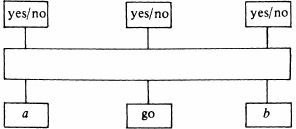
Consider the general experimental set-up of Fig. 7. To avoid inessential details it is represented just as a long box of unspecified equipment, with three inputs and three outputs. The outputs, above in the figure, can be three pieces of paper, each with either ‘yes’ or ‘no’ printed on it. The central input is just a ‘go’ signal which sets the experiment off at time tx. Shortly after that the central output says ‘yes’ or ‘no’. We are only interested in the ‘yes’s, which confirm that everything has got off to a good start (e.g., there are no ‘particles’ going in the wrong directions, and so on).
- gill1109
- Mathematical Statistician
- Posts: 2812
- Joined: Tue Feb 04, 2014 10:39 pm
- Location: Leiden
Re: The mother of all quantum challenges
by gill1109 » Sun May 18, 2014 12:06 am
minkwe wrote:It turns out what he really wants is for others to implement a nonsensical/physically naive algorithm erroneously attributed to non-locality/non-realism, so that if it fails the rigged challenge, he can continue to believe in the voodoo of "non-realism"/non-locality.
What I would like is that Michel would tell us if this challenge can be won. Maybe Michel will also explain why Bell seemed to think this experimental protocol so important - see chapters 13 and 16 of "Speakable and Unspeakable". Maybe Michel can explain why experimentalists are presently excited because they believe they are close to a successful experiment running under such a protocol, carefully designed to prevent any of the well-known "loopholes" from providing an alternative explanation to the observed correlations.
I am not interested in voodoo. I'm interested in science. Does Michel think the experimentalists will be succesful? Notice that last years' experiments by the Zeilinger group and the Gisin group were not afflicted by the detection loophole. That was the first time ever, for photon polarization experiments. A lot of progress is being made. The experimentalists are at last heeding Caroline Thompson's advice concerning how to analyse the data. Jan-Ake Larsson and Andrei Khrennikov are working with them on the statistical side. These are exciting developments.
- gill1109
- Mathematical Statistician
- Posts: 2812
- Joined: Tue Feb 04, 2014 10:39 pm
- Location: Leiden
Re: The mother of all quantum challenges
by gris » Sun May 18, 2014 4:38 am
Well Richard, to show you how I think entanglement works a short You tube video: (it is part of a playlist about the forgotten instrument between the ears. In the prior films I show how you should deal with logically solving problems of this nature and thus use mathematics: the reason why the history of folly repeats itself.) I also show how my photon is built up of two strings of six gluons each counter-rotating and how that has come about. The fields are the un-spun Higgs field and un-spun graviton field. The latter having the possibility of creating the needed spin 2 turning thus a Higgs boson into a spin 1 gluon.
Seen like that there is no more Vodoo. It all is nicely Newton again. It might even leave your statistics untouched. https://www.youtube.com/watch?v=1kx1B7v ... eK3JH3Dl4F
Seen like that there is no more Vodoo. It all is nicely Newton again. It might even leave your statistics untouched. https://www.youtube.com/watch?v=1kx1B7v ... eK3JH3Dl4F
- gris
- Posts: 38
- Joined: Thu Feb 20, 2014 12:12 pm
Re: The mother of all quantum challenges
by gill1109 » Mon May 19, 2014 12:07 am
gris wrote:Well Richard, to show you how I think entanglement works a short You tube video: (it is part of a playlist about the forgotten instrument between the ears. In the prior films I show how you should deal with logically solving problems of this nature and thus use mathematics: the reason why the history of folly repeats itself.) I also show how my photon is built up of two strings of six gluons each counter-rotating and how that has come about. The fields are the un-spun Higgs field and un-spun graviton field. The latter having the possibility of creating the needed spin 2 turning thus a Higgs boson into a spin 1 gluon.
Seen like that there is no more Vodoo. It all is nicely Newton again. It might even leave your statistics untouched. https://www.youtube.com/watch?v=1kx1B7v ... eK3JH3Dl4F
Win the computer challenge. Then you have explained how entanglement works.
Trouble is, it's logically impossible to do.
- gill1109
- Mathematical Statistician
- Posts: 2812
- Joined: Tue Feb 04, 2014 10:39 pm
- Location: Leiden
Re: The mother of all quantum challenges
by gris » Mon May 19, 2014 2:12 am
No Richard the trouble is that it probably is solvable. You are making exactly the same error in reasoning as the people who think the Zeno paradox is an actual contradiction whereas it is only a seeming contradiction. That is easy to prove yet has its roots in neuro-psychology as well. The forgotten instrument between the ears. It starts off with seeing that DSM V is a Bayesian inversion. One half deems the other half mad dumb lazy and what not. They don't understand that humor is a survival trait and that only in the safe situation can half the populace make an above average correct guess on an average problem we have to solve in order to survive. Humor is relative thought.
I'll explain the problem via Zeno: it is sort of a fools mate on the chess board of reason. The error is not seeing that the lingual solution is best in immediately spotting that Achilles will overtake the tortoise assuming he doesn't have a heart-attack or what not. And that the quasi verbal mathematical problem starts off with a fallacy namely overly complicating a simple problem i.e. in effect letting Achilles slow down. Infringing on the stated probandum that has already been solved and providing an illusion of a better solution because it seemingly provides a more accurate answer via mathematics. You infringe on the Lex parsimony. Then claiming your solution is better mathematics further more provides the illusion of having something of an absolute truth. That doesn't exist, for if you believe that you are a religious scientist. Most scientists are in effect religious scientists BTW not being able to let go of the paradigm banana as depicted in my DSM 6 model in which everyone is mad and we only have a few normal ones as a Bayesian inversion of the boring DSM 7 in which everyone except a few are normal again. That should be used in the court rooms for otherwise half the populace won't understand it anymore. Because DSM 6 is more fun let me prove to you you are wrong:
https://www.youtube.com/watch?v=83aGieH ... eK3JH3Dl4F
In this film: 1:57 the distribution of our Big Four mad monkeys: the gorilla: logic on authority freezer big ego: the baboon same freezer yet small ego (both 80% populace AND 80% fast thinkers scientists as well) and 10% Bonobo logic on relation higher stress level flirter creative open-minded humor on sales and 9% chimps creative open-minded logic on goal fighters higher stress level humor on goal still and 1% fearless logic on self is big ego thus Gorilla. Mind you everyone is all sorts of monkey more or less! (More full explanation see the rest of the films.) Now see the difference of how a mistake making chimp solves this R&D problem correctly and how the 80% flawless freezers do that wrong (Mother Nature / God has 80% for production being production minded) Well is this entanglement a sales a production or an R&D problem? Venture to guess?:
Mature adult educated guesswork and test that that is what should be done.
7:41 confirmation bias
8:28 scary Out of the Box manic oversight and depressing pounce on the problem.
9:20 oversight
9:35 where do you think you are at? Small rift or large one? Large one => verbal logic no maths then.
12:06 Yin and Yang proof freezer can only hack yin or yang when unsafe when safe only half (mind safe is strange! safe on goal!) => problem more book wisdom less progress.
14:00 chess board of reason error of reasoning forgetting the boundaries between laws.
24:15 proof of three valid tests to be better done in stead of your simulation. test 1 find order if order => instant paradigm shift end of your position
37:58 test 2 if gravity is observed to rise => instant paradigm shift end of your position
39:18 test 3 if photon red-shift anomaly => instant paradigm shift end of your position
41:17 rest of verbal and drawing concept => possible other ways to test
I'll explain the problem via Zeno: it is sort of a fools mate on the chess board of reason. The error is not seeing that the lingual solution is best in immediately spotting that Achilles will overtake the tortoise assuming he doesn't have a heart-attack or what not. And that the quasi verbal mathematical problem starts off with a fallacy namely overly complicating a simple problem i.e. in effect letting Achilles slow down. Infringing on the stated probandum that has already been solved and providing an illusion of a better solution because it seemingly provides a more accurate answer via mathematics. You infringe on the Lex parsimony. Then claiming your solution is better mathematics further more provides the illusion of having something of an absolute truth. That doesn't exist, for if you believe that you are a religious scientist. Most scientists are in effect religious scientists BTW not being able to let go of the paradigm banana as depicted in my DSM 6 model in which everyone is mad and we only have a few normal ones as a Bayesian inversion of the boring DSM 7 in which everyone except a few are normal again. That should be used in the court rooms for otherwise half the populace won't understand it anymore. Because DSM 6 is more fun let me prove to you you are wrong:
https://www.youtube.com/watch?v=83aGieH ... eK3JH3Dl4F
In this film: 1:57 the distribution of our Big Four mad monkeys: the gorilla: logic on authority freezer big ego: the baboon same freezer yet small ego (both 80% populace AND 80% fast thinkers scientists as well) and 10% Bonobo logic on relation higher stress level flirter creative open-minded humor on sales and 9% chimps creative open-minded logic on goal fighters higher stress level humor on goal still and 1% fearless logic on self is big ego thus Gorilla. Mind you everyone is all sorts of monkey more or less! (More full explanation see the rest of the films.) Now see the difference of how a mistake making chimp solves this R&D problem correctly and how the 80% flawless freezers do that wrong (Mother Nature / God has 80% for production being production minded) Well is this entanglement a sales a production or an R&D problem? Venture to guess?:
Mature adult educated guesswork and test that that is what should be done.
7:41 confirmation bias
8:28 scary Out of the Box manic oversight and depressing pounce on the problem.
9:20 oversight
9:35 where do you think you are at? Small rift or large one? Large one => verbal logic no maths then.
12:06 Yin and Yang proof freezer can only hack yin or yang when unsafe when safe only half (mind safe is strange! safe on goal!) => problem more book wisdom less progress.
14:00 chess board of reason error of reasoning forgetting the boundaries between laws.
24:15 proof of three valid tests to be better done in stead of your simulation. test 1 find order if order => instant paradigm shift end of your position
37:58 test 2 if gravity is observed to rise => instant paradigm shift end of your position
39:18 test 3 if photon red-shift anomaly => instant paradigm shift end of your position
41:17 rest of verbal and drawing concept => possible other ways to test
- gris
- Posts: 38
- Joined: Thu Feb 20, 2014 12:12 pm
Re: The mother of all quantum challenges
by gill1109 » Tue May 20, 2014 2:05 am
I don't need your paradigm shift. I have my own.
- gill1109
- Mathematical Statistician
- Posts: 2812
- Joined: Tue Feb 04, 2014 10:39 pm
- Location: Leiden
Re: The mother of all quantum challenges
by gris » Tue May 20, 2014 6:43 am
It's about a collective paradigm shift that everybody agrees on that is sought after.
Problem is, my way is fully logically tied in with everything. In order to see what quantum entanglement is about you first need to see if the problem of marrying GR to QM has probably become more complex or more simple as I state due to acquiring more relevant data. The latter is of course the case. If so you must logically lower the norm in order to get an integral oversight of the whole situation in order to see where to start testing. And thus not try and get hung up on conundrums that predictably ensue when trying to very accurately solve part issues.
Logically you Richard are in such a conundrum. You must first go back to basics. Especially if your final conclusion is that the problem is inherently unsolvable. You need to spot that the absolutely straight flying mass-less photon that has a strange relation to the speed of light and time both in GR and QM has never been observed. It is a galloping unicorn that can simply be supplanted by an other such unicorn with mass and the ability to accelerate. All mathematics of the laws of GR and QM stay the same. It then is all a hologram built by gravitons that are not in spin can cause spin two giving the un-spun Higgs boson a spin 1 turning it into a Gluon that forms the strings of which it all is built up. Six Gluons spiraling to the right in a spiraling string interlocked with six spiraling to the right. That is your photon. Problem elegantly solved via Newton. No conundrum and testable.
Now then refute my argument that it has logically probably got simpler. For if you can't (which you can't) you logically can't maintain your claim that it is inherently unsolvable. That - for my idea - can only be so if my proposed tests are mathematically falsified in view of the known or further obtained observations.
In short you took a wrong turn already before you got started.
Problem is, my way is fully logically tied in with everything. In order to see what quantum entanglement is about you first need to see if the problem of marrying GR to QM has probably become more complex or more simple as I state due to acquiring more relevant data. The latter is of course the case. If so you must logically lower the norm in order to get an integral oversight of the whole situation in order to see where to start testing. And thus not try and get hung up on conundrums that predictably ensue when trying to very accurately solve part issues.
Logically you Richard are in such a conundrum. You must first go back to basics. Especially if your final conclusion is that the problem is inherently unsolvable. You need to spot that the absolutely straight flying mass-less photon that has a strange relation to the speed of light and time both in GR and QM has never been observed. It is a galloping unicorn that can simply be supplanted by an other such unicorn with mass and the ability to accelerate. All mathematics of the laws of GR and QM stay the same. It then is all a hologram built by gravitons that are not in spin can cause spin two giving the un-spun Higgs boson a spin 1 turning it into a Gluon that forms the strings of which it all is built up. Six Gluons spiraling to the right in a spiraling string interlocked with six spiraling to the right. That is your photon. Problem elegantly solved via Newton. No conundrum and testable.
Now then refute my argument that it has logically probably got simpler. For if you can't (which you can't) you logically can't maintain your claim that it is inherently unsolvable. That - for my idea - can only be so if my proposed tests are mathematically falsified in view of the known or further obtained observations.
In short you took a wrong turn already before you got started.
- gris
- Posts: 38
- Joined: Thu Feb 20, 2014 12:12 pm
Re: The mother of all quantum challenges
by gris » Tue May 20, 2014 9:50 am
Just came up with a different answer all together having us all being right: you assume that photons are mass-less right? Or in effect you don't assume that, you simply look at the statistics and conclude it is unsolvable. Well agree when photons are mass-less it is mathematically proven that it is unsolvable magic => photons must have mass then. Remember photons are not only dissonant in nature they also are extrapolations that fit both GR & QM whereas GR and QM don't fit.
- gris
- Posts: 38
- Joined: Thu Feb 20, 2014 12:12 pm
Re: The mother of all quantum challenges
by gill1109 » Wed May 21, 2014 9:05 am
I do not say that the problem of understanding quantum correlation is unsolvable, Mr gris.
The "mother of all quantum challenges" is designed to help people like you find out what that problem actually is. But apparently it does not work on everybody.
The "mother of all quantum challenges" is designed to help people like you find out what that problem actually is. But apparently it does not work on everybody.
- gill1109
- Mathematical Statistician
- Posts: 2812
- Joined: Tue Feb 04, 2014 10:39 pm
- Location: Leiden
46 posts
• Page 1 of 3 • 1, 2, 3
Return to Sci.Physics.Foundations
Who is online
Users browsing this forum: Baidu [Spider] and 134 guests