Page 1 of 2

Margenau's argument

PostPosted: Fri Oct 16, 2020 10:37 am
by local
FrediFizzx wrote: It was shot down in 2007 by Joy Christian.

Arguably it was first (preemptively) shot down by Margenau in 1935, who showed that the 'EPR paradox' was a result of incorrect application of projection, aka, collapse of the wave function. There are many roads to Rome!

Re: Margenau's argument

PostPosted: Fri Oct 16, 2020 10:51 am
by FrediFizzx
local wrote:
FrediFizzx wrote: It was shot down in 2007 by Joy Christian.

Arguably it was first (preemptively) shot down by Margenau in 1935, who showed that the 'EPR paradox' was a result of incorrect application of projection, aka, collapse of the wave function. There are many roads to Rome!

Did Margenau have a model that was a decisive counter example to Bell's junk physics theory? If so, got any links? Well, never mind as 1935 was pre-Bell so Margenau couldn't have shot Bell down. :) But perhaps interesting just the same.
.

Re: Margenau's argument

PostPosted: Fri Oct 16, 2020 10:56 am
by local
FrediFizzx wrote: Did Margenau have a model that was a decisive counter example to Bell's junk physics theory? If so, got any links? Well, never mind as 1935 was pre-Bell so Margenau couldn't have shot Bell down. :) But perhaps interesting just the same.

Yes Fred, that is why I referred to it as preemptive. If his critique of projection for the EPR scenario is accepted, Bell's theorem simply cannot be proven for separated measurement situations (where the joint prediction is inapplicable). It's analogous to your point about a fallback to a different bound on the inequality (< 4 instead of < 2). It is also an effective rejoinder to those who say "Bell's theorem is just simple mathematics". Graft and Khrennikov (separately, not as co-authors) have endorsed this analysis (with refinements) in recent years.

H. Margenau, “Quantum-Mechanical Description”, Physical Review 49, 240-242 (1935)

As I said, there are many roads to Rome, i.e., a junk theory likely has many directions from which it can be shown to be nonsense.

Re: Margenau's argument

PostPosted: Fri Oct 16, 2020 1:48 pm
by FrediFizzx
Here is a link to the Margenau paper for those that might be interested.

http://www.psiquadrat.de/downloads/margenau1936.pdf
.

Re: Margenau's argument

PostPosted: Fri Oct 16, 2020 5:29 pm
by local
Thanks for the link, Fred!

Re: Margenau's argument

PostPosted: Fri Oct 16, 2020 6:31 pm
by FrediFizzx
local wrote:Thanks for the link, Fred!

You're welcome but I don't think I can agree with Margenau. For me, his eq. (1) should be . I have no problem with the wavefunction vanishing on the act of measurement. The probability is simply zero then.
.

Re: Margenau's argument

PostPosted: Sat Oct 17, 2020 8:27 am
by local
Actually, Fred, you are agreeing with him. His point is that the postulate that a measurement must result in an eigenvalue of the observable is not necessarily always true. His equation 1 is a corollary of that postulate, so he is challenging it, not asserting it. Your case of the collapse of the wave function to 0 is one important example of the cases he has in mind. Graft wrote:

"Projection is simply false for many real physical scenarios. Some measurements do not give the same result upon repetition, e.g., because the system is annihilated (photons disappear upon detection), or because the measurement involves an unpredictable violent disturbance."

Thank you for splitting the thread. This important perspective deserves its own thread, I believe.

Re: Margenau's argument

PostPosted: Sat Oct 17, 2020 9:17 am
by FrediFizzx
local wrote:Actually, Fred, you are agreeing with him. His point is that the postulate that a measurement must result in an eigenvalue of the observable is not necessarily always true. His equation 1 is a corollary of that postulate, so he is challenging it, not asserting it. Your case of the collapse of the wave function to 0 is one important example of the cases he has in mind. Graft wrote:

"Projection is simply false for many real physical scenarios. Some measurements do not give the same result upon repetition, e.g., because the system is annihilated (photons disappear upon detection), or because the measurement involves an unpredictable violent disturbance."

Thank you for splitting the thread. This important perspective deserves its own thread, I believe.

Oh, you are right sort of. "His point is that the postulate that a measurement must result in an eigenvalue of the observable is not necessarily always true." It is that part that I am not sure I agree with. What does that mean with regards to the EPR experiment scenario? That a click is not recorded for every particle?
.

Re: Margenau's argument

PostPosted: Sat Oct 17, 2020 10:16 am
by local
FrediFizzx wrote: Oh, you are right sort of. "His point is that the postulate that a measurement must result in an eigenvalue of the observable is not necessarily always true." It is that part that I am not sure I agree with. What does that mean with regards to the EPR experiment scenario? That a click is not recorded for every particle?

Margenau famously rejects projection in any form for any scenario, so he means that after one side does its measurement, the other side's source state is not physically projected (changed) in any way. Quantum mysterians and Bell acolytes must apply Luders projection to get a pure state superposition at the second side (because without that you cannot derive the cosine correlation). A less restrictive view is that there are some situations where it is OK to apply projection (though not necessarily Luders projection; it could be Von Neumann projection or something else) but EPRB is not one of them due to the separated measurements. No projection at all (null projection) is correct for separated EPRB.

Of course this rejection of quantum correlation applies for the usual spacetime. If spacetime is a 3/7-sphere then one can develop an argument that quantum correlation is in fact real. I am not qualified to assess the validity of such an argument.

If quantum correlation is rejected then Bell's Theorem cannot be proven, because the quantum and classical predictions coincide.

Re: Margenau's argument

PostPosted: Sun Oct 18, 2020 8:31 am
by FrediFizzx
local wrote:
FrediFizzx wrote: Oh, you are right sort of. "His point is that the postulate that a measurement must result in an eigenvalue of the observable is not necessarily always true." It is that part that I am not sure I agree with. What does that mean with regards to the EPR experiment scenario? That a click is not recorded for every particle?

Margenau famously rejects projection in any form for any scenario, so he means that after one side does its measurement, the other side's source state is not physically projected (changed) in any way. Quantum mysterians and Bell acolytes must apply Luders projection to get a pure state superposition at the second side (because without that you cannot derive the cosine correlation). A less restrictive view is that there are some situations where it is OK to apply projection (though not necessarily Luders projection; it could be Von Neumann projection or something else) but EPRB is not one of them due to the separated measurements. No projection at all (null projection) is correct for separated EPRB.

Of course this rejection of quantum correlation applies for the usual spacetime. If spacetime is a 3/7-sphere then one can develop an argument that quantum correlation is in fact real. I am not qualified to assess the validity of such an argument.

If quantum correlation is rejected then Bell's Theorem cannot be proven, because the quantum and classical predictions coincide.

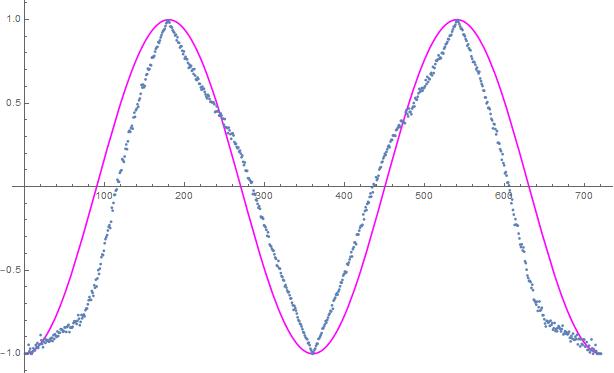
Ah yes, you are working to discredit the experiments. Hmm... Interesting as you may not be discrediting them in the way perhaps they should be discredited. Take this crazy plot for example,

Image

That plot actually exceeds CHSH by a lot. It gives 2.93 for CHSH. IOW, it is not even close to the quantum prediction but still exceeds CHSH. There are a lot of similar plots that do the same. So, perhaps the experiments are not really doing the quantum predictions. Just a thought.
.

Re: Margenau's argument

PostPosted: Sun Oct 18, 2020 9:32 am
by local
Curious to know what produced that plot. But again, there are many roads to Rome.

Sure, I work to discredit the experiments. They are all nonsense, even the so-called "loophole-free" ones. It's all silly Kabuki theater employed to protect egos, grants, positions, and reputations. The mysterians will still be making excuses after a century of failed implementation of "quantum computing". It must be hard when your life's work is shown to be nonsense.

But more importantly I work to show the total absence of any theoretical basis for quantum correlations in separated measurement situations (for normal 3D space topology). The stupid "passion at a distance" nonsense is not theory. It is fantasy. The silly "information that cannot be accessed is not really information" gambit is and has been easily discredited.

Am I radical enough for you? :lol:

Re: Margenau's argument

PostPosted: Sun Oct 18, 2020 10:49 am
by FrediFizzx
local wrote:Curious to know what produced that plot. ...

The A and B functions are pretty straight forward in Mathematica,

If[Cos[(a - s[[j]]) Degree] > 0, A = 1, A = -1];
If[Cos[(b - s[[j]]) Degree] > 0, B = -1, B = 1];

However, the singlet spin vector function is somewhat radical,

s[[j]] = RandomChoice[{0, 10, 20, RandomReal[{0, 360}]}];

Yes, you are plenty radical enough. :D
.

Re: Margenau's argument

PostPosted: Sun Oct 18, 2020 11:07 am
by local
Thank you, Fred. Gonna try it. I like radical too.

Re: Margenau's argument

PostPosted: Sun Oct 18, 2020 11:31 am
by FrediFizzx
local wrote:Thank you, Fred. Gonna try it. I like radical too.

You're welcome. For the a and b functions, I just did,

a = RandomInteger[{0, 360}]; (*Detector vector angle 1 degree increments*)
b = RandomInteger[{0, 360}];

It makes doing theta = (a - b) a lot easier to calculate and the rest of the analysis since Mathematica is using theta as an index. I'll clean up the code and post the whole Mathematica notebook file some time today.
.

Re: Margenau's argument

PostPosted: Sun Oct 18, 2020 1:13 pm
by gill1109
local wrote:
FrediFizzx wrote: Oh, you are right sort of. "His point is that the postulate that a measurement must result in an eigenvalue of the observable is not necessarily always true." It is that part that I am not sure I agree with. What does that mean with regards to the EPR experiment scenario? That a click is not recorded for every particle?

Margenau famously rejects projection in any form for any scenario, so he means that after one side does its measurement, the other side's source state is not physically projected (changed) in any way. Quantum mysterians and Bell acolytes must apply Luders projection to get a pure state superposition at the second side (because without that you cannot derive the cosine correlation). A less restrictive view is that there are some situations where it is OK to apply projection (though not necessarily Luders projection; it could be Von Neumann projection or something else) but EPRB is not one of them due to the separated measurements. No projection at all (null projection) is correct for separated EPRB.

Of course this rejection of quantum correlation applies for the usual spacetime. If spacetime is a 3/7-sphere then one can develop an argument that quantum correlation is in fact real. I am not qualified to assess the validity of such an argument.

If quantum correlation is rejected then Bell's Theorem cannot be proven, because the quantum and classical predictions coincide.

Those who are looking for a theory which reproduces the predictions of quantum theory (or reproduce it to a decent approximation) do not apply or need Lüders projection postulate. They do not use any quantum theory at all. Or any particular interpretation of quantum theory. They merely search for a theory which is able to reproduce (to a decent approximation) the statistical data collected in 2015 in Vienna, Delft, Munich and at NIST in Boulder Colorado, while adopting the restrictions on spatial and temporal disposition of settings and outcomes, which were freely adopted in those experiments. That data does fit nicely to quantum mechanical theories.

You may be sure that we would have heard it, if the data proved any standard quantum theory to be wrong!. Anybody who could have proven an incompatibility with generally accepted quantum theory would now be a hot contender for a Nobel prize! Especially if they had an alternative theory which did explain those experimental results. I haven't seen one yet.

The phrases "Quantum mysterians" and "Bell acolytes" are emotional phrases, more at home in a Trump rally than a scientific discussion. OK. So you don't like some people's point of view? No problem. We all have our feelings, we all have deeply cherished opinions. But in Science, boyo, I'm afraid they are up from grabs.If you want to show that someone else's point of view is totally wrong, you have to *prove* that that point of view is wrong.

You weaken your own argument by your use of language!

Re: Margenau's argument

PostPosted: Sun Oct 18, 2020 1:22 pm
by local
gill1109 wrote: Those who are looking for a theory...do not use any quantum theory

Great advice. And

more at home in a Trump rally than a scientific discussion

Gill jumps the shark. Bravo!

Re: Margenau's argument

PostPosted: Sun Oct 18, 2020 1:25 pm
by FrediFizzx
Here is a PDF of the Mathematica code that exceeds CHSH.

EPRsims/newCS-7-2.pdf

And here is the notebook file.

EPRsims/newCS-7-2.nb

Enjoy!
.

Re: Margenau's argument

PostPosted: Sun Oct 18, 2020 1:28 pm
by local
Thank you, Fred!

Re: Margenau's argument

PostPosted: Sun Oct 18, 2020 1:50 pm
by FrediFizzx
local wrote:Thank you, Fred!

You're welcome. Oops, slight error when I cleaned up the code but doesn't affect the result. Take out,

b = RandomInteger[{0, 360}];

in the a Do loop.
.

Re: Margenau's argument

PostPosted: Sun Oct 18, 2020 5:12 pm
by local
Got it, thank you, Fred.