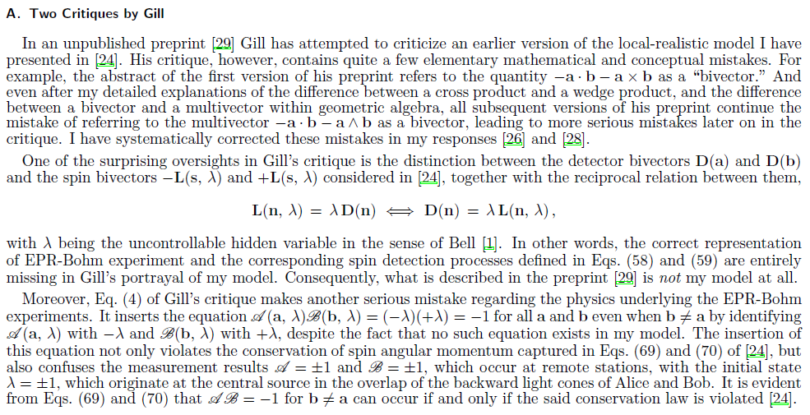
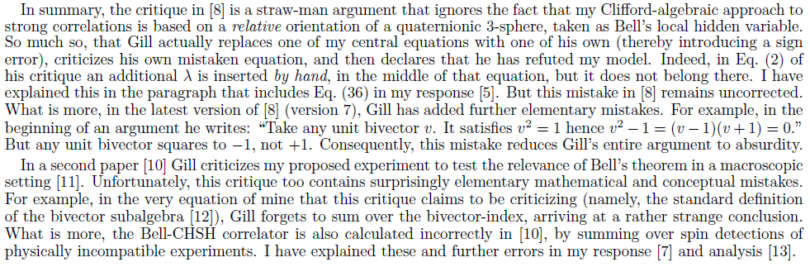
FrediFizzx wrote:@gill1109 Same old junk physics and math, and lies; different day.
Well, the junk physics and math and the lies are elsewhere! Take a look at
https://rpubs.com/jjc/13965, in particular, this text:
- Code: Select all
## This version has been adapted from Richard Gill's optimized version of
## Michel Fodje's original simulation of the model, which can be found here:
## http://rpubs.com/gill1109/EPRB3opt. Later Richard Gill improved his 3D
## version by employing the exact probability distribution derived by Philip
## Pearle in his classic 1970 paper: http://rpubs.com/gill1109/Pearle. It
## should be noted, however, that, unlike Pearle's model, the 3-sphere model
## has nothing whatsoever to do with data rejection or detection loophole.
## All of the above simulations are inspired by the original simulation of
## the 3-sphere model by Chantal Roth, https://github.com/chenopodium/JCS2.
First of all, Michel Fodje never wrote a simulation of Christian's model. He invented his own detection loophole and coincidence loophole models and published the Python code of them. He saw them as local realistic models which reproduced experimental results. He did not like the names "detection loophole" and "coincidence loophole". But that doesn't matter. None of these simulations were inspired by Chantal Roth's. Mine was a simulation of Pearle's model, which I learnt about from papers by Caroline Thompson, who published detection loophole models long, long ago. Caroline's models had nice physical interpretations, unlike Pearle's. But they did not produce the negative cosine exactly, only approximately. But good enough that one would not have been able to see the difference, with experimentally available data.
Chantal's model is a simple calculation using quaternions. In GA terms, she simply computes the real part of
a b, and she even says that that is what she is doing! Her program was inspired by John Reeds' Mathematica implementation of some formulas in some of Christian's papers, which later resulted in that GA Viewer simulation. Which .... effectively, simply computes the real part of
a b while adding some noise due to binning of "continuous" angles in discrete bins.
It is not even physics. It's just some elementary maths disguised as physics. In my opinion, it would make a rather nice hoax (cf. Sokal and Sneath). This is a fantastic "stress test" on present day scientific publishing.
 Posted: Tue Feb 16, 2021 8:35 am