
Computer Simulation of EPR Scenarios
Re: Computer Simulation of EPR Scenarios
 by gill1109 » Fri Feb 14, 2014 2:57 am
- gill1109
- Mathematical Statistician
- Posts: 2812
- Joined: Tue Feb 04, 2014 10:39 pm
- Location: Leiden
Re: Computer Simulation of EPR Scenarios
by gill1109 » Fri Feb 14, 2014 9:29 am


To illustrate that all three correlations are definitely different, here are simulation estimates together with standard errors (sample size 1 million) at one particular angle
- Code: Select all
> angles[16]*180/pi
[1] 112.5
>
> round(corrs2[16], 4)   ## S2
[1] -0.3716
> round(cos(angles[16]),  4)
[1] -0.3827
> round(corrs3[16],  4)   ## S3
[1] -0.3897
>
> round(1/sqrt(Ns2[16]), 4)   ## standard error S2
[1] 0.0012
> round(1/sqrt(Ns3[16]), 4)   ## standard error S3
[1] 0.0013
- gill1109
- Mathematical Statistician
- Posts: 2812
- Joined: Tue Feb 04, 2014 10:39 pm
- Location: Leiden
Re: Computer Simulation of EPR Scenarios
by Heinera » Fri Feb 14, 2014 11:55 am
 )
)- Heinera
- Posts: 917
- Joined: Thu Feb 06, 2014 1:50 am
Re: Computer Simulation of EPR Scenarios
by Joy Christian » Fri Feb 14, 2014 2:46 pm
Heinera wrote:Fantastic observation by Richard! Given the obvious connection to the detection loophole, at least I assumed that Christian and Fodje managed to get the correlations correct, since this is not difficult to achieve... And the connection to Caroline Thompson's paper is just priceless. I'll follow this up after the weekend when I have analysed it further (and there went some weekend plans down the drain
It should be noted that all Gill has managed to establish is that he has not been able to reproduce Michel's simulation either as competently or as correctly as both Michel and John Reed have been able to.
Those who are familiar with his past failures would also recognize that he has a tendency to get carried away with his own misconceptions rather than recognizing that he has actually failed to understand what he is analyzing. More to the point, anyone who has actually bothered to study my longer paper linked above would have noticed that the simulations by Chantal Roth and Michel Fodje in fact complement each other rather nicely. Each simulation exhibits a different representation of one and the same geometrical and topological structure of the 3-sphere. There is no mystery to why both simulations exactly reproduce the singlet correlation, albeit appearing at first sight to be quite different. As I have stressed many times before, EPR-Bohm correlations are correlations among the points of a parallelized 3-sphere. Of course if the flatlanders would rather continue to view these correlations in a primitive way from their perspective of
PS: Here is the longer paper I referred to above: http://libertesphilosophica.info/blog/w ... hapter.pdf
- Joy Christian
- Research Physicist
- Posts: 2793
- Joined: Wed Feb 05, 2014 4:49 am
- Location: Oxford, United Kingdom
Re: Computer Simulation of EPR Scenarios
by Heinera » Fri Feb 14, 2014 2:55 pm
Joy Christian wrote:Heinera wrote:Fantastic observation by Richard! Given the obvious connection to the detection loophole, at least I assumed that Christian and Fodje managed to get the correlations correct, since this is not difficult to achieve... And the connection to Caroline Thompson's paper is just priceless. I'll follow this up after the weekend when I have analysed it further (and there went some weekend plans down the drain
It should be noted that all Gill has managed to establish is that he has not been able to reproduce Michel's simulation either as competently or as correctly as both Michel and John Reed have been able to.
I will obviously use Michel's original Python code to analyse this., since I have both the neccessary Python skills and tools. Then we'll see.
- Heinera
- Posts: 917
- Joined: Thu Feb 06, 2014 1:50 am
Re: Computer Simulation of EPR Scenarios
by Joy Christian » Fri Feb 14, 2014 3:00 pm
Heinera wrote:Joy Christian wrote:Heinera wrote:Fantastic observation by Richard! Given the obvious connection to the detection loophole, at least I assumed that Christian and Fodje managed to get the correlations correct, since this is not difficult to achieve... And the connection to Caroline Thompson's paper is just priceless. I'll follow this up after the weekend when I have analysed it further (and there went some weekend plans down the drain
It should be noted that all Gill has managed to establish is that he has not been able to reproduce Michel's simulation either as competently or as correctly as both Michel and John Reed have been able to.
I will obviously use Michel's original Python code to analyse this., given that I have both the neccessary Python skills and tools. Then we'll see.
Good luck! You may need this longer paper to understand my theoretical reasoning (to be honest, I don't much care about simulations): http://libertesphilosophica.info/blog/w ... hapter.pdf
- Joy Christian
- Research Physicist
- Posts: 2793
- Joined: Wed Feb 05, 2014 4:49 am
- Location: Oxford, United Kingdom
Re: Computer Simulation of EPR Scenarios
by gill1109 » Sat Feb 15, 2014 12:17 am
Comparison of S^1 and S^2 versions of minkwe's / Joy Christian's / Caroline Thompson model:
http://rpubs.com/gill1109/13325
Chantal Roth's simple model:
http://rpubs.com/gill1109/13324
Chantal's model is S^1 based.
Caroline Thompson's basic model had circular caps of fixed size on a sphere. Obviously one can do the same kind of thing on the circle. As Caroline pointed out, to make the model more accurately reproduce quantum correlations, one should make the boundaries of the caps a bit fuzzy in some way or another. The Minkwe/Joy solution is to give them the same but random radius. Chantal's solution is more in line with Caroline's idea.
- gill1109
- Mathematical Statistician
- Posts: 2812
- Joined: Tue Feb 04, 2014 10:39 pm
- Location: Leiden
Re: Computer Simulation of EPR Scenarios
by gill1109 » Sat Feb 15, 2014 12:46 am
Heinera wrote:Fantastic observation by Richard! Given the obvious connection to the detection loophole, at least I assumed that Christian and Fodje managed to get the correlations correct, since this is not difficult to achieve... And the connection to Caroline Thompson's paper is just priceless. I'll follow this up after the weekend when I have analysed it further (and there went some weekend plans down the drain
I am not sure that it is so easy to get the correlations *perfect*. It is easy to get a very close approximation to the cosine curve. It is known that one can get arbitrarily close. However I am not aware of a detection loophole type simulation which generates *exactly* the cosine.
- gill1109
- Mathematical Statistician
- Posts: 2812
- Joined: Tue Feb 04, 2014 10:39 pm
- Location: Leiden
Re: Computer Simulation of EPR Scenarios
by Joy Christian » Sat Feb 15, 2014 1:31 am
gill1109 wrote:Chantal's model is S^1 based.
Caroline Thompson's basic model had circular caps of fixed size on a sphere. Obviously one can do the same kind of thing on the circle. As Caroline pointed out, to make the model more accurately reproduce quantum correlations, one should make the boundaries of the caps a bit fuzzy in some way or another. The Minkwe/Joy solution is to give them the same but random radius. Chantal's solution is more in line with Caroline's idea.
Here is a perfect example of how Gill deliberately and calculatedly tries to misrepresent other people's work if it does not fit his deeply held flatlander ideology. For example, he bluntly states: "Chantal's model is S^1 based." To begin with, Chantal does not have a model as far as I know. She did help me to simulate my 3-sphere model, which has absolutely nothing to do with Caroline Thompson's model (who was hounded by Bell-believers until her untimely death for challenging the Bell ideology). In any case, here is what Chantal actually states, right at the beginning of her simulation of my 3-sphere model (for reference, see my paper linked above):
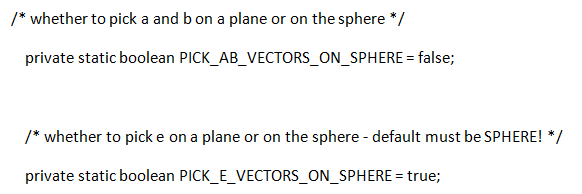
This is a perfect example of how Gill often tries to deliberately mislead the physics community. He compares his own simulation with Caroline Thompson's model and triumphantly declares that his own misconceptions have something to do with my 3-sphere model and its two complementary simulations by Chantal Roth and Michel Fodje, respectively. He can only see my
The bottom line is that until Gill understands what a parallelized 3-sphere is he is unlikely to understand what my model actually is. Here is where you can find a good discussion of what a parallelized 3-sphere is and why it is physically significant: http://arxiv.org/abs/1211.0784. A simulation of a simulation of
- Joy Christian
- Research Physicist
- Posts: 2793
- Joined: Wed Feb 05, 2014 4:49 am
- Location: Oxford, United Kingdom
Re: Computer Simulation of EPR Scenarios
by gill1109 » Sat Feb 15, 2014 1:39 am
I think we are talking about two different simulation programs written by Chantal. I am only talking about event-based simulations. I am referring to her basic framework for event-based EPR simulation models
https://github.com/chenopodium/EPR
There is a simple model hidden there in the java code. It is easy to rewrite in mathematics, or for that matter in R.
http://rpubs.com/gill1109/13324
Richard
PS fortunately it is not necessary to know any physics at all in order to read Michel's description of his algorithm and to study his code and to re-write it in a different programming language. It is useful to know something about statistics, scientific programming, and statistical programming, in order to increase the accuracy (both numerical and statistical) of his simulation. It would be helpful if you gained some knowledge in this direction so that you yourself would be able to judge whether or Michel's code effectively simulates *exactly* a cosine or only to a close approximation.
- gill1109
- Mathematical Statistician
- Posts: 2812
- Joined: Tue Feb 04, 2014 10:39 pm
- Location: Leiden
Re: Computer Simulation of EPR Scenarios
by Joy Christian » Sat Feb 15, 2014 2:07 am
gill1109 wrote:...It is useful to know something about statistics, scientific programming, and statistical programming, in order to increase the accuracy (both numerical and statistical) of his simulation. It would be helpful if you gained some knowledge in this direction so that you yourself would be able to judge whether or Michel's code effectively simulates *exactly* a cosine or only to a close approximation.
It is indeed useful to know something about statistics. A good discussion of which, as applied to my model, can be found here
Scientific programming and statistical programing may be useful, but in the end they can only help with simulations of any analytical model. Otherwise why don't we all just sit in a flight-simulator instead of flying, or simulate atomic bombs rather than dropping them, or simulate particles rather than building accelerators.
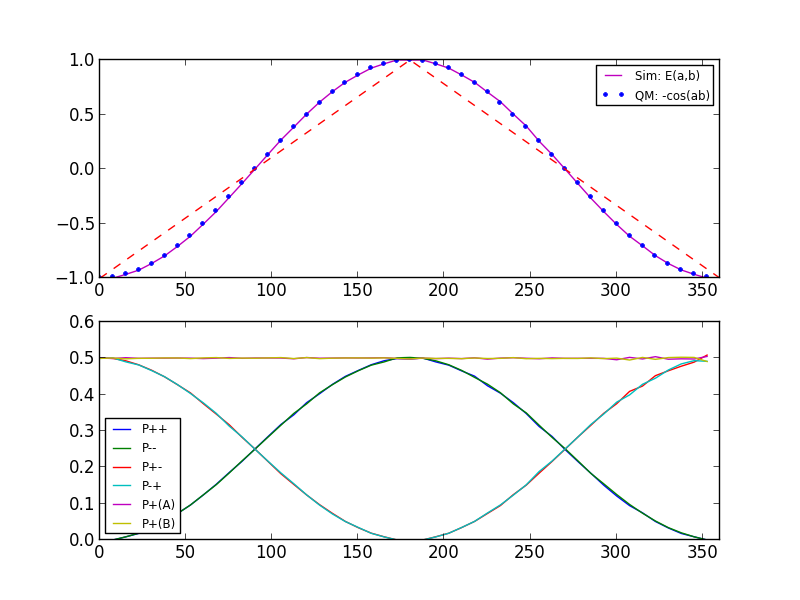
The point is that even if Michel's simulation only effectively simulates an approximation to a cosine curve, so what? It ain't a model. It is a simulation of a model.
In any case, here is what Michel's simulation of my 3-sphere model actually produces:
- Joy Christian
- Research Physicist
- Posts: 2793
- Joined: Wed Feb 05, 2014 4:49 am
- Location: Oxford, United Kingdom
Re: Computer Simulation of EPR Scenarios
by gill1109 » Sat Feb 15, 2014 2:44 am
My plots are upside down relative to yours. I multiply Alice's outcome by -1 so as to get perfect correlation, not anti-correlation, at equal settings.
- gill1109
- Mathematical Statistician
- Posts: 2812
- Joined: Tue Feb 04, 2014 10:39 pm
- Location: Leiden
Re: Computer Simulation of EPR Scenarios
by Joy Christian » Sat Feb 15, 2014 2:59 am
gill1109 wrote:And now let's zoom in ...
This zooming-in is done in YOUR
- Joy Christian
- Research Physicist
- Posts: 2793
- Joined: Wed Feb 05, 2014 4:49 am
- Location: Oxford, United Kingdom
Re: Computer Simulation of EPR Scenarios
by gill1109 » Sat Feb 15, 2014 3:52 am
I am not talking about any Monte Carlo verifications of particular analytical ingredients of your model.
Moreover I implemented both Michel's algorithm (which picks random angles in [0, 2 pi], i.e., points on the circle) as well as "lifted it" from the circle to the sphere, which actually brings it *closer* - both in spirit, and in terms of implementation of your formulas, and in terms of the final results - to the descriptions in your documents EPRB.pdf and complete.pdf. The blue is Michel's (one could call it "S^1" or "R^2" based), the red is my lifting (one could call it "S^2" or "R^3" based), the black is the cosine of Nature, God, whoever... The three differ from one another by about 0.001; the Monte Carlo accuracy is about 0.0001.
I suggest you ask "mink we" to add error-bars to his simulated curves so we can all judge for ourselves, whether or not they "prove" something about your model.
- gill1109
- Mathematical Statistician
- Posts: 2812
- Joined: Tue Feb 04, 2014 10:39 pm
- Location: Leiden
Re: Computer Simulation of EPR Scenarios
by gill1109 » Sat Feb 15, 2014 10:43 am
- gill1109
- Mathematical Statistician
- Posts: 2812
- Joined: Tue Feb 04, 2014 10:39 pm
- Location: Leiden
Re: Computer Simulation of EPR Scenarios
by minkwe » Sat Feb 15, 2014 10:55 am
Now it appears you are worried not about whether the CHSH is violated but about how close the plots from the simulation are to the perfect cosine relationship. May I suggest you revise your plots to also include the experimental results from at least 2 experiments so that you may gain some perspective about what the experimental results "prove" about QM.
- minkwe
- Posts: 1441
- Joined: Sat Feb 08, 2014 10:22 am
Re: Computer Simulation of EPR Scenarios
by Joy Christian » Sat Feb 15, 2014 11:49 am
All three of Chantal's fish are swimming in a boxed aquarium (i.e., in
- Joy Christian
- Research Physicist
- Posts: 2793
- Joined: Wed Feb 05, 2014 4:49 am
- Location: Oxford, United Kingdom
Re: Computer Simulation of EPR Scenarios
by FrediFizzx » Sat Feb 15, 2014 12:00 pm

- FrediFizzx
- Independent Physics Researcher
- Posts: 2905
- Joined: Tue Mar 19, 2013 7:12 pm
- Location: N. California, USA
Re: Computer Simulation of EPR Scenarios
by gill1109 » Sat Feb 15, 2014 1:27 pm
minkwe wrote:Richard,
Now it appears you are worried not about whether the CHSH is violated but about how close the plots from the simulation are to the perfect cosine relationship. May I suggest you revise your plots to also include the experimental results from at least 2 experiments so that you may gain some perspective about what the experimental results "prove" about QM.
I am not worried at all, Minkwe. And I don't need to re-run a simulation in order to judge how accurate its results are. There are other ways to get error bars. Ever heard of the one over root N law?
I am amused that it is now statistically proven that your model is not a simulation of Joy's model, since Joy's model predicts the cosine, and yours is a little bit off. Because I have confidence in my statistics I am not going to waste time doing the calculus.
- gill1109
- Mathematical Statistician
- Posts: 2812
- Joined: Tue Feb 04, 2014 10:39 pm
- Location: Leiden
Re: Computer Simulation of EPR Scenarios
by gill1109 » Sat Feb 15, 2014 1:29 pm
FrediFizzx wrote:Yeah, It doesn't really matter that any computer simulation doesn't match perfectly with a cosine curve. It is definitely not a straight line!
Sure, but then everyone has known (or at least: should have known) since Pearle (1970) how to get curves close to a cosine. It's called the detection loophole.
- gill1109
- Mathematical Statistician
- Posts: 2812
- Joined: Tue Feb 04, 2014 10:39 pm
- Location: Leiden
Return to Sci.Physics.Foundations
Who is online
Users browsing this forum: No registered users and 98 guests