
The following is my response to the 10,000 Euros challenge announced by Richard Gill. You can read the terms of his challenge on these two posts here and here.
As required by the terms of the challenge, here are the two text files, AliceDirections.txt and BobDirections.txt, containing N spin directions I have postulated to occur within my proposed macroscopic experiment. Each of the lines in each text file contains two numbers, which represent the x and y coordinates of the spin directions for Alice and Bob, confined to the equatorial plane, in a right-handed coordinate system. The R script of the simulation which produces the spin directions, u_k(x,y) for Alice and -u_k(x,y) for Bob, can be found here. The script may also explain the notations and conventions used for the computations that follow.
For technical reasons of producing the text files from the R script, Fred and I have had to separate out the x and y components of the u matrix and bind them again in the matrix e = cbind(t,w), as defined in the R script. But I have also left the directions tables from the u matrix in the script, just in case someone has difficulty using the x and y components generated from the e matrix. Note also that Fred has checked the e-lists against the u output and the "good" truth table, and they match.
I have left the number of trials rather low, N = 10,000, but that should be fine for the present purposes. Needless to say, statistics can be improved with a larger N.
Since the challenge is about my proposed experiment (which is supposed to test my 3-sphere model for the EPR-Bohm correlation), it is very important that this response to the challenge is evaluated with a "good" deal of understanding of my model. Sadly, in my opinion, Richard Gill has not understood my model despite considerable efforts. I hope that he or anyone else who wishes to evaluate my response to his challenge, does so in the light of my latest paper on the subject.
In compliance with the terms of the challenge, correlations are computed for the four pairs of "Bell test angles", 0 and 90 degrees for Alice and 45 and 135 degrees for Bob, in the standard manner, using the standard formula for the correlation function,
E(a, b) = 1/N sum_k A_k B_k ,
with A_k = sign(a . u_k[good]) and B_k = -sign(b . u_k[good]) being the standard functions, appearing, for example, in the original model proposed by Bell in 1964.
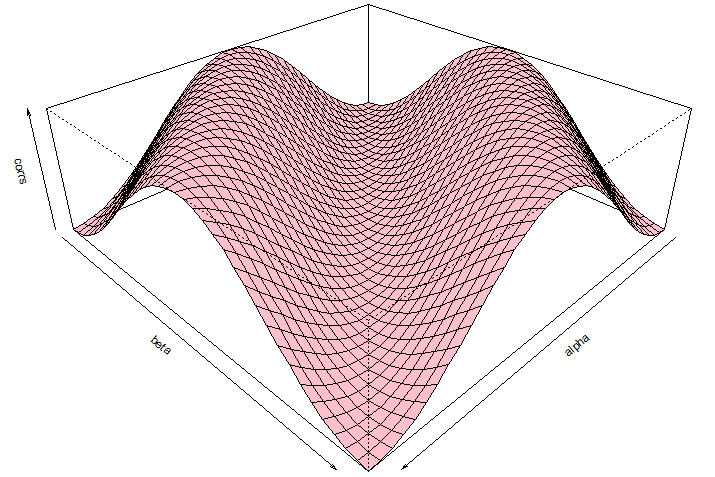
The results of these computations turn out to be spectacular, with Bell-CHSH inequality violated, as can be appreciated from the correlation surface shown below: