FrediFizzx wrote:The wikipedia page for Lorentz Force in the Lagrangian section says,
"The action is the relativistic arclength of the path of the particle in space time, minus the potential energy contribution, plus an extra contribution which quantum mechanically is an extra phase a charged particle gets when it is moving along a vector potential."
Does that help at all?
Hi Fred,
I see that you are looking at
https://en.wikipedia.org/wiki/Lorentz_f ... _mechanics. At a certain level, yes, because the last two terms are the covariant form of the four potential. But no, because I want to see a tight and direct connection to the metric of spacetime.
I have thought about this quite a bit over the weekend while in Boston / Cambridge, where I am always inspired back to my roots at MIT where the most important thing I learned way beyond any specific curriculum is that I can figure out anything if I really put my mind to it. MIT is the place I really learned how to think.
I am now pretty well convinced that the term to be varied must have something close to the form:

(1)
Specifically, if we put the metric interval

together with a supplemental term
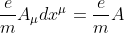
for the potential one-form, then by dimensional analysis we are comparing apples to apples in

units because the mass dimension of both terms is -1 and because each of g and A are gauge potentials. Also, by putting the derivation of gravitational geodesics together with the derivation of the Lorentz force geodesics the former can lend the needed acceleration term

to the latter and the latter can lend a resulting term with

to the former that contains a velocity and a field strength which will appear when the variation operates on the potential.
This week I will do the calculation of
https://en.wikipedia.org/wiki/Geodesics ... _an_action but using (1) above rather than just
alone, and see if it in fact, as I suspect, it will lead to the fourth equation in
https://en.wikipedia.org/wiki/Geodesics ... d_particle which then contains both forms of motion, without plunking in the Lorentz force as is done in the Wiki article.
I would be interest in whether anybody has ever seen the expression (1) before?
Jay


 )
)