Gull and Gill's theory

Foundations of physics and/or philosophy of physics, and in particular, posts on unresolved or controversial issues

Re: Gull and Gill's theory

Postby Joy Christian » Tue Nov 10, 2020 7:53 am

local wrote:
...Joy takes the mysterians' position at face value and argues that it does not imply quantum nonlocality...

To be precise, I subscribe to Einstein's position that quantum mechanics is a correct theory of Nature but it is not a complete theory of Nature. This means that all predictions of quantum mechanics, including those of the singlet correlations, are correct predictions. This was Einstein's position and I subscribe to it fully. With Einstein, I also believe that quantum mechanics is not a complete theory of Nature. But it has been completed in my papers, in a limited sense, with an explicit local-realistic model for the quantum correlations, thereby realizing Einstein's dream of completing quantum mechanics.

***
Joy Christian
Research Physicist
 
Posts: 2793
Joined: Wed Feb 05, 2014 4:49 am
Location: Oxford, United Kingdom

Re: Gull and Gill's theory

Postby local » Tue Nov 10, 2020 7:57 am

That's perfectly fine and not inconsistent with what I said. I would just add that while QM may be correct, it can be incorrectly applied and/or interpreted, as exemplified by the quantum mysterians.
local
 
Posts: 295
Joined: Mon Aug 05, 2019 1:19 pm

Re: Gull and Gill's theory

Postby gill1109 » Tue Nov 10, 2020 8:34 am

local wrote:Gill did ask me whether my mind is open or "made up", so now he is quibbling about the meaning of "quibbling".

I don't care about Gill's unrelated accomplishments or his proof of Bell's inequality, which has been proved many many times before by more important thinkers. I care about Gill's failure to provide a derivation of -a.b for separated systems, or to acknowledge the real physical distinction between joint and separated measurement. Those are the technical points that I referred to and Gill well knows that. His duplicity is obvious for all to see. What choice does he have when his entire career in quantum foundations is based on nonsense?

You know, I am so proud of my bricklaying on a wonderful building in Prague. But who cares in our context here? Unlike Gill, my ego is under control.

Good that your ego is under control, “local”. Good that you too have accomplishments you are proud of.

But what is really great is that you admit you cannot provide a derivation of -a.b for separated classical systems. You agree with Gull’s and Gill’s (and many others’) claims, that such a derivation is impossible.

I would be delighted to hear a physicist expounding on the “real physical distinction” between joint and separated measurement.
gill1109
Mathematical Statistician
 
Posts: 2812
Joined: Tue Feb 04, 2014 10:39 pm
Location: Leiden

Re: Gull and Gill's theory

Postby local » Tue Nov 10, 2020 8:45 am

gill1109 wrote: But what is really great is that you admit you cannot provide a derivation of -a.b for separated classical systems.

More disgusting duplicity. I never claimed to have one for classical systems. And I never doubted Bell-like inequalities. As an admitted amateur it's not surprising that you would fail to apprehend simple things.

I would be delighted to hear a physicist expounding on the “real physical distinction” between joint and separated measurement.

Then bring one of your mysterian buddies like Larsson over here. They won't come because like you, they are playing the see-no-evil game. And there goes your ego again. Nobody cares what delights you. Get over yourself!

I'll be gone for a few hours so won't be able to continue playing your last-wordism game until I return.
Last edited by local on Tue Nov 10, 2020 8:54 am, edited 5 times in total.
local
 
Posts: 295
Joined: Mon Aug 05, 2019 1:19 pm

Re: Gull and Gill's theory

Postby FrediFizzx » Tue Nov 10, 2020 8:45 am

gill1109 wrote:
FrediFizzx wrote:Of course Jay has local measurement functions for A and B. How else would you demonstrate that QM is local for the EPR-Bohm scenario? Simply backtrack from the product calculation.
.

Dear Fred,

Jay does a routine QM calculation of the singlet correlations. He has a meta-physical discussion in which he argues that Hilbert space operators are *real* because their non-commuting character is reflected in real correlations which could not otherwise exist. They are *local* because they are associated with two different measurements going on at two different places.

He does not have local measurement functions. He does not have a particle-by-particle model which produces individual pairs of outcomes in two processes in two separated environments. He does not have an event-based local realist simulation model.

You should read what he wrote, instead of projecting your own wishful thinking about what you dreamt he wrote.

His point of view is common among old school physicists. I saw it a lot among people of the generation of Gerard ‘t Hooft and the generation before that. The Copenhagen school was dominant; Bohr had won the debate with Einstein. If you wanted a career in a physics department you stuck to the official line and stayed clear of foundational debate.

Sorry, but you are completely clueless about what Jay did. I don't care about what Jay wrote for his explanations. I care about what his equations say. And..., they say that QM is local for the EPR-Bohm scenario. But you don't understand his equations at all because you can't even tell me the equation numbers for his A and B measurement functions and I even gave you a clue.
.
FrediFizzx
Independent Physics Researcher
 
Posts: 2905
Joined: Tue Mar 19, 2013 7:12 pm
Location: N. California, USA

Re: Gull and Gill's theory

Postby FrediFizzx » Tue Nov 10, 2020 9:49 am

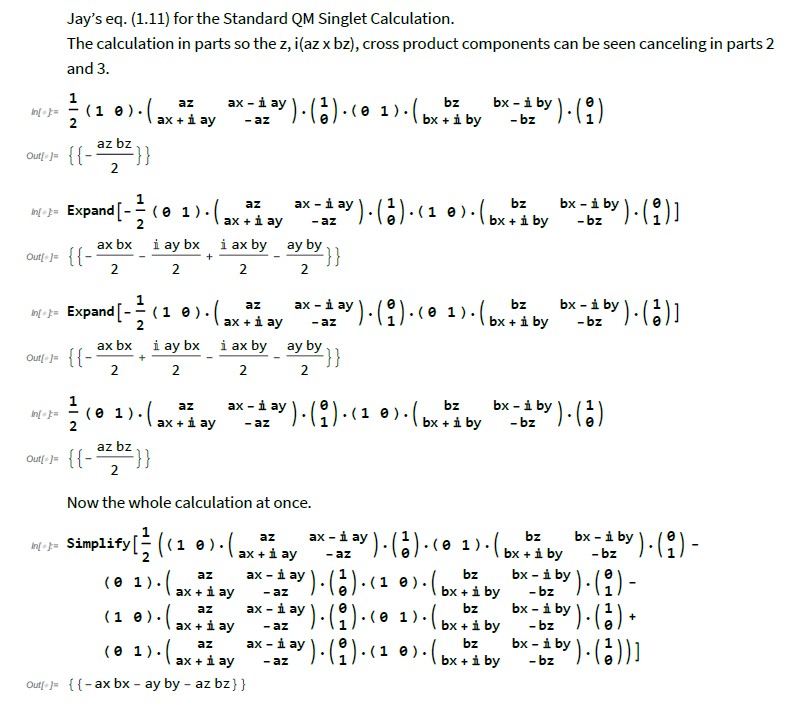
Here is a fairly simple QM joint calculation of -a.b a little bit different from what Jay wrote,

Image
.
FrediFizzx
Independent Physics Researcher
 
Posts: 2905
Joined: Tue Mar 19, 2013 7:12 pm
Location: N. California, USA

Re: Gull and Gill's theory

Postby FrediFizzx » Tue Nov 10, 2020 3:57 pm

FrediFizzx wrote:Here is a fairly simple QM joint calculation of -a.b a little bit different from what Jay wrote,

Image
.

I have to say that in this calculation, a, b and the singlet particles (1 and 0 matrices) all seem to be physically local to each other and we know that is not the case in the experiments.
.
FrediFizzx
Independent Physics Researcher
 
Posts: 2905
Joined: Tue Mar 19, 2013 7:12 pm
Location: N. California, USA

Re: Gull and Gill's theory

Postby gill1109 » Wed Nov 11, 2020 12:17 am

What do you mean by “a, b and the singlet particles (1 and 0 matrices) all seem to be physically local to each other and we know that is not the case in the experiments”?

In the 2015 experiments, a is chosen “outside” of Alice’s lab, and inserted into an apparatus there. At the other end of the campus, b is chosen “outside” of Bob’s lab, and inserted into an apparatus there. The two labs have their +/-1 outcomes before the other’s setting could have been transmitted from A to B or vice-versa.

They also did it with a and b generated by distant quasars outside of one another’s light cones. https://journals.aps.org/prl/abstract/10.1103/PhysRevLett.121.080403

In this Letter, we present a cosmic Bell experiment with polarization-entangled photons, in which measurement settings were determined based on real-time measurements of the wavelength of photons from high-redshift quasars, whose light was emitted billions of years ago; the experiment simultaneously ensures locality. Assuming fair sampling for all detected photons and that the wavelength of the quasar photons had not been selectively altered or previewed between emission and detection, we observe statistically significant violation of Bell’s inequality by 9.3 standard deviations, corresponding to an estimated p value of ≲ 7.4 × 10^−21. This experiment pushes back to at least ∼7.8 Gyr ago the most recent time by which any local-realist influences could have exploited the “freedom-of-choice” loophole to engineer the observed Bell violation, excluding any such mechanism from 96% of the space-time volume of the past light cone of our experiment, extending from the big bang to today.
Last edited by gill1109 on Wed Nov 11, 2020 12:58 am, edited 1 time in total.
gill1109
Mathematical Statistician
 
Posts: 2812
Joined: Tue Feb 04, 2014 10:39 pm
Location: Leiden

Re: Gull and Gill's theory

Postby FrediFizzx » Wed Nov 11, 2020 12:36 am

gill1109 wrote:What do you mean by “a, b and the singlet particles (1 and 0 matrices) all seem to be physically local to each other and we know that is not the case in the experiments”?
...

Are you still asleep? It means just what it says. It also means that the QM prediction of -a.b may only be good when every thing is local to each other. The same might hold true for all product calculations. Hmmm.... maybe local has a good point.
.
FrediFizzx
Independent Physics Researcher
 
Posts: 2905
Joined: Tue Mar 19, 2013 7:12 pm
Location: N. California, USA

Re: Gull and Gill's theory

Postby gill1109 » Wed Nov 11, 2020 1:03 am

FrediFizzx wrote:
gill1109 wrote:What do you mean by “a, b and the singlet particles (1 and 0 matrices) all seem to be physically local to each other and we know that is not the case in the experiments”?
...

Are you still asleep? It means just what it says. It also means that the QM prediction of -a.b may only be good when every thing is local to each other. The same might hold true for all product calculations. Hmmm.... maybe local has a good point.
.

No, I got up three hours ago.

The 2015 experiments do *not* find -a.b. They didn’t try to. They engineered different states, different measurements. They had two labs a mile distant from one another. Take a look at https://arxiv.org/abs/1808.06863.

Very strong evidence in favor of quantum mechanics and against local hidden variables from a Bayesian analysis
Yanwu Gu, Weijun Li, Michael Evans, Berthold-Georg Englert
The data of four recent experiments --- conducted in Delft, Vienna, Boulder, and Munich with the aim of refuting nonquantum hidden-variables alternatives to the quantum-mechanical description --- are evaluated from a Bayesian perspective of what constitutes evidence in statistical data. We find that each of the experiments provides strong, or very strong, evidence in favor of quantum mechanics and against the nonquantum alternatives. This Bayesian analysis supplements the previous non-Bayesian ones, which refuted the alternatives on the basis of small p-values, but could not support quantum mechanics.

“Local” does have some good points. “Local” moreover seems to agree with me, Gull, and Bell, that classical, separated, systems, can’t reproduce the singlet correlations. They (“local”, a bricklayer from Prague) just can’t bring themselves to say so. They do agree with me that Gordon Watson’s disproof of Bell’s theorem is a failure. They wisely refrain from commenting on Joy Christian’s theory, saying that Christian uses topologies they are not familiar with. I have studied Dr Christian’s proofs and the interesting thing is that he does not introduce novel topologies at all. His norms are Euclidean norms on (subsets of) real vector spaces of finite dimension.
gill1109
Mathematical Statistician
 
Posts: 2812
Joined: Tue Feb 04, 2014 10:39 pm
Location: Leiden

Re: Gull and Gill's theory

Postby FrediFizzx » Wed Nov 11, 2020 1:28 am

I thought I told you to STOP posting nonsense!
.
FrediFizzx
Independent Physics Researcher
 
Posts: 2905
Joined: Tue Mar 19, 2013 7:12 pm
Location: N. California, USA

Re: Gull and Gill's theory

Postby Joy Christian » Wed Nov 11, 2020 2:35 am

gill1109 wrote:
["local"] wisely refrain from commenting on Joy Christian’s theory, saying that Christian uses topologies they are not familiar with. I have studied Dr Christian’s proofs and the interesting thing is that he does not introduce novel topologies at all. His norms are Euclidean norms on (subsets of) real vector spaces of finite dimension.

Learn something from "local." You correctly note that "local" wisely refrains from commenting on my model. You should do the same instead of pretending that you are qualified to judge it.

***
Joy Christian
Research Physicist
 
Posts: 2793
Joined: Wed Feb 05, 2014 4:49 am
Location: Oxford, United Kingdom

Re: Gull and Gill's theory

Postby Austin Fearnley » Wed Nov 11, 2020 2:41 am

FrediFizzx wrote:What was the angle between a and b? Or doesn't it matter?
.

OOPS! I cannot simplify the way the measurements are collected. Data still need to be collected in exact pairs. My simplified method of recording data could only work if we knew which measurements were positrons and which were electrons, and that is an unknown.
Austin Fearnley
 

Re: Gull and Gill's theory

Postby gill1109 » Wed Nov 11, 2020 4:52 am

Austin Fearnley wrote:theta = 35.1 deg (i.e. the angle whose -cos equals -0.818)
I hadn't bothered to work out the angle before as the 'proof' will work with any angle.

One can look at the table in two ways.
1. Assume that the original data are from genuine matched pairs of particles in a Bell experiment, relying on entanglement only.

My randomisation shows that the correl results would not change if we no longer bothered to match up the pairs. One needs to randomise as I previously wrote. That is we randomise B values within A values. Or randomise A values within B values. It may possibly be argued that this is a spurious effect as all the original data are from exactly matched pairs, and we do not know what would have been measured in the real experiment if the pairs had not been matched.

Second way. 2. Assume that the original data are from unmatched pairs in a Bell experiment, based on my method relying on polarisation (which does not need exact matches.)

The randomisation here also does not change the correlation and shows that you can get the correlation from any such ordering of the data. That is what you would expect from a method not relying on exactly matched pairs.

This second way has not been tested by a real experiment so there is no proof that we will get -a.b. It is doubtful that any real experiment historically took any measurements from unmatched pairs?

Suppose you have an n x 2 spreadsheet filled with 0s and 1s. Columns are called “A” and “B”. If you reorder the rows for which A = 0, and reorder the rows for which A = 1, you’ll end up with the same 2x2 table with rows labelled by a =0 and a =1, and columns labelled by b = 0 and b = 1, and such that the cell (a, b) contains the number of rows with (A,B) = (a,b).

Real experiments define paired time slots in the two wings of the experiment. At the start of each time slot, a setting is introduced into some device. By the end of the time slot, some data has been received and, by some computation or other fast electronics, a binary outcome is computed. I don’t know what you mean by “matched pairs”. The experimenter defines the time slots. The experimenter tends to believe in quantum mechanics and is so good at quantum engineering that mostly, the two photons within just one photon pair trigger the detection physics. The experimenter is generally aiming to make something happen which can’t be explained by non-conspiratorial local realistic theories. Nowadays, lots of people are studying theories which can be called conspiratorial. Do not take that in a derogatory sense. The idea is that the experimenter is deluded in thinking they can input arbitrary settings. Instead, the settings he or she “chooses” are determined either by events in the far future, or by events in the deep past.

See https://arxiv.org/abs/1912.06462.

Rethinking Superdeterminism

S. Hossenfelder, T.N. Palmer
Quantum mechanics has irked physicists ever since its conception more than 100 years ago. While some of the misgivings, such as it being unintuitive, are merely aesthetic, quantum mechanics has one serious shortcoming: it lacks a physical description of the measurement process. This "measurement problem" indicates that quantum mechanics is at least an incomplete theory -- good as far as it goes, but missing a piece -- or, more radically, is in need of complete overhaul.
Here we describe an approach which may provide this sought-for completion or replacement: Superdeterminism. A superdeterministic theory is one which violates the assumption of Statistical Independence (that distributions of hidden variables are independent of measurement settings). Intuition suggests that Statistical Independence is an essential ingredient of any theory of science (never mind physics), and for this reason Superdeterminism is typically discarded swiftly in any discussion of quantum foundations.
The purpose of this paper is to explain why the existing objections to Superdeterminism are based on experience with classical physics and linear systems, but that this experience misleads us. Superdeterminism is a promising approach not only to solve the measurement problem, but also to understand the apparent nonlocality of quantum physics. Most importantly, we will discuss how it may be possible to test this hypothesis in an (almost) model independent way.

Last edited by gill1109 on Wed Nov 11, 2020 4:57 am, edited 1 time in total.
gill1109
Mathematical Statistician
 
Posts: 2812
Joined: Tue Feb 04, 2014 10:39 pm
Location: Leiden

Re: Gull and Gill's theory

Postby local » Wed Nov 11, 2020 4:53 am

gill1109 wrote: “Local” does have some good points. “Local” moreover seems to agree with me, Gull, and Bell, that classical, separated, systems, can’t reproduce the singlet correlations. They (“local”, a bricklayer from Prague) just can’t bring themselves to say so.

I have repeatedly stated that I do not believe you can get -a.b for space-like EPRB (for classical and quantum systems).
Last edited by local on Wed Nov 11, 2020 6:47 am, edited 2 times in total.
local
 
Posts: 295
Joined: Mon Aug 05, 2019 1:19 pm

Re: Gull and Gill's theory

Postby gill1109 » Wed Nov 11, 2020 5:03 am

Yes, local, you repeatedly say “I have repeatedly stated that I do not believe you can get -a.b for space-like EPRB”. But you don’t say whether you are working within quantum mechanics, or within local realism, or both. Do you think you can get -a.b on separated PC’s? The thread here is called “Gull and Gill’s theory”. The name was given by Fred Diether, who made the first post in this topic. Gull and Gill are talking about simulations with classical, classically networked, PC’s.

I’m just wondering about your opinion on that issue. Maybe you are just not interested in it. OK by me!

Here’s a link to the “state of play” concerning Gull’s proof. https://www.math.leidenuniv.nl/~gill/gull.pdf. Fred asked me to come back when the paper was finished. There has been a lot of progress.
Last edited by gill1109 on Wed Nov 11, 2020 5:11 am, edited 1 time in total.
gill1109
Mathematical Statistician
 
Posts: 2812
Joined: Tue Feb 04, 2014 10:39 pm
Location: Leiden

Re: Gull and Gill's theory

Postby local » Wed Nov 11, 2020 5:10 am

gill1109 wrote: But you don’t say whether you are working within quantum mechanics, or within local realism, or both.

No system can obtain -a.b for space-like separated EPRB, and my posts specifically say so. The Graft papers I have cited make that obvious as well.
local
 
Posts: 295
Joined: Mon Aug 05, 2019 1:19 pm

Re: Gull and Gill's theory

Postby jreed » Wed Nov 11, 2020 7:35 am

FrediFizzx wrote:Here is a fairly simple QM joint calculation of -a.b a little bit different from what Jay wrote,

Image
.

I don't see any equation 1.11 in the paper referenced earlier. Which paper did that equation come from?
jreed
 
Posts: 176
Joined: Mon Feb 17, 2014 5:10 pm

Re: Gull and Gill's theory

Postby Austin Fearnley » Wed Nov 11, 2020 8:19 am

gill1109 wrote: by gill1109 » Wed Nov 11, 2020 4:52 am

Austin Fearnley wrote:
theta = 35.1 deg (i.e. the angle whose -cos equals -0.818)
I hadn't bothered to work out the angle before as the 'proof' will work with any angle.

ETC ETC ...

Sorry, I retracted that idea back on page 4 of this thread on
Tue Nov 10, 2020 12:58 am.
1. My deflated and retracted idea for a simplified system could only have worked if we could know which measurements were on positrons and which were on electrons, and that is not possible. So one must use pair-at-a-time as currently used.

2. My retro method can work with any system of choosing detector spin settings. The conspiracy in my retro method is caused by Alice's measured positrons forcing [via entanglement] Bob's [and one could interchange Alice and Bob here for symmetry]
incoming electrons to be pre-polarised in the direction of Alice's detector setting. If the settings are going to change rapidly this requires polarisation to be a property of a single particle and not just of a beam. But this is fine as I have my own (classical) model of a single polarised electron. So you can change the settings as often as you want and the electron measurement will always use the correct difference in angle a-b whatever a and b were at the time of measurement.

3. Superdeterminism. I have read papers by Tim and Sabine, including essays on the FQXi 2020 essay competition and on the Backreaction blog. I do not wish to knock this method but will say what it is that stops me, at the moment, from agreeing wholeheartedly.
It seems like a fatalistic approach. The distribution of particle spin vectors is not random because the block universe already exists and there is no free will. And not all particle spin vectors have occurred, so it is tough luck if you think you can simulate any particle spin vector at random. I sympathise to some extent as the lack of a free choice of spin vectors does IMO agree with Wheeler and Feynmans Advanced and Retarded waves. Particle interactions are a transaction between effects emanating from now (retarded waves) and emanating from the future (advanced waves).

The fractal or chaotic nature of a measurement outcome in the superdeterminist idea is also useful. I lean more to the word fractal as that implies some order. Chaos sounds, as a word, to be completely random. I have model of a polarised particle which incorporates a random element but not completely random. My model is classical and does not use p-adic numbers.

So IMO I have solved the -a.b correlation result. For any continually-randomised arrangement of spin detectors. I have bypassed the need for p-adics and chaotic measurement outcomes by devising a polarised particle model and have already put a paper online showing how to compute the controlled random measurement outcome. The randomness is associated with uncertainty in the measurement outcome (which contravenes counterfactual determinism, and simultaneously fails the Randi challenge). It also means that there is no randomless-formula to determine exactly for a single particle what the measurement result is.

IMO my retro solution is more complete and less fatalistic than superdeterminism. Though how can a basic classical method really compete with the excitement of p-adics!?
Austin Fearnley
 

Re: Gull and Gill's theory

Postby FrediFizzx » Wed Nov 11, 2020 11:32 am

jreed wrote:
FrediFizzx wrote:Here is a fairly simple QM joint calculation of -a.b a little bit different from what Jay wrote,

Image
.

I don't see any equation 1.11 in the paper referenced earlier. Which paper did that equation come from?

I've split this off to a new topic.
.
FrediFizzx
Independent Physics Researcher
 
Posts: 2905
Joined: Tue Mar 19, 2013 7:12 pm
Location: N. California, USA

PreviousNext

Return to Sci.Physics.Foundations

Who is online

Users browsing this forum: ahrefs [Bot] and 115 guests

CodeCogs - An Open Source Scientific Library