
Gull and Gill's theory

Foundations of physics and/or philosophy of physics, and in particular, posts on unresolved or controversial issues

Re: Gull and Gill's theory

Postby FrediFizzx » Mon Dec 07, 2020 2:40 pm

gill1109 wrote:
FrediFizzx wrote:
gill1109 wrote:Sorry Fred, I should have said “request”, not “question”. You made a request of me, to “do a correct QM prediction with separated measurements”. I declined to deliver. It doesn’t matter, for my theorem. Bell’s theorem is confirmed. Do you have a problem with that? Bell doesn’t say that -a.b is “correct”. He said explicitly that maybe it is not correct. Many people (physicists, doing quantum mechanics) thought it could indeed not be correct. Bell’s theorem (in my reading) says you can’t get -a.b from a local, realistic, non-conspiratorial theory...

Well, of course that is just plain false. Bell's junk physics theory says nothing about having to use the event by event outcomes that you are imposing. What is more, since your theory doesn't distinguish classical or quantum, you are saying that Nature can't do it. Well, the experiments themselves have already shot you down on that matter. But if you want to waste your time on junk stuff, be my guest. :mrgreen:

... If they existed, and if you could program them, then you could create an event by event simulation of the type Gull imposed. (Gull demands even more than I do. I allow the two computers to talk to each other between trials. Gull demanded that they never talk to each other; not ever). ...

Here is an example of how misguided your requirement is that A and B must run on separate computers. It is extremely easy to program a single computer to behave like 3 separate computers.
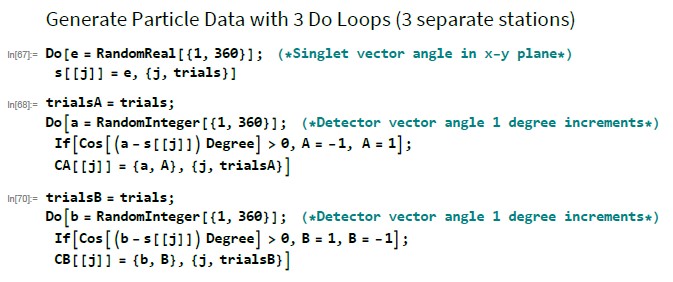
Image
.
FrediFizzx
Independent Physics Researcher
 
Posts: 2905
Joined: Tue Mar 19, 2013 7:12 pm
Location: N. California, USA

Re: Gull and Gill's theory

Postby gill1109 » Mon Dec 07, 2020 11:58 pm

FrediFizzx wrote:
gill1109 wrote:
FrediFizzx wrote:
gill1109 wrote:Sorry Fred, I should have said “request”, not “question”. You made a request of me, to “do a correct QM prediction with separated measurements”. I declined to deliver. It doesn’t matter, for my theorem. Bell’s theorem is confirmed. Do you have a problem with that? Bell doesn’t say that -a.b is “correct”. He said explicitly that maybe it is not correct. Many people (physicists, doing quantum mechanics) thought it could indeed not be correct. Bell’s theorem (in my reading) says you can’t get -a.b from a local, realistic, non-conspiratorial theory...

Well, of course that is just plain false. Bell's junk physics theory says nothing about having to use the event by event outcomes that you are imposing. What is more, since your theory doesn't distinguish classical or quantum, you are saying that Nature can't do it. Well, the experiments themselves have already shot you down on that matter. But if you want to waste your time on junk stuff, be my guest. :mrgreen:
...
What do *you* think *is* Bell's theorem? ...

What do you think is Bell's theorem? Obviously you think it is something more than it really is. I know exactly what it is straight from Bell himself.

viewtopic.php?f=6&t=441
.

OK, we are agreed on what is Bell's theorem.

FrediFizzx wrote:Here is an example of how misguided your requirement is that A and B must run on separate computers. It is extremely easy to program a single computer to behave like 3 separate computers.

Image
.

Of course it is easy to program a single computer to behave like 3 separate computers.

It is also easy to check whether or not a program, like yours, could be separated and run on 3 separate computers, such that

1) "source" sends information to "alice" and "bob"
2) "alice" asks for a setting, and after getting a setting delivers an output
3) "bob" asks for a setting, and after getting a setting delivers an output

Gull's theorem is a theorem saying that it cannot be done *and* produce the singlet statistics when run many, many times
gill1109
Mathematical Statistician
 
Posts: 2812
Joined: Tue Feb 04, 2014 10:39 pm
Location: Leiden

Re: Gull and Gill's theory

Postby FrediFizzx » Tue Dec 08, 2020 9:55 am

gill1109 wrote: ... Gull's theorem is a theorem saying that it cannot be done *and* produce the singlet statistics when run many, many times.

Except you guys messed up since quantum theory can't do it either. So, you are saying NOTHING can do it. But we know that Nature probably does do it from the experiments. Or, at least whatever it is is not linear. Ya shot yourself in the foot on that one. :mrgreen:
.
FrediFizzx
Independent Physics Researcher
 
Posts: 2905
Joined: Tue Mar 19, 2013 7:12 pm
Location: N. California, USA

Re: Gull and Gill's theory

Postby gill1109 » Tue Dec 08, 2020 9:43 pm

FrediFizzx wrote:
gill1109 wrote: ... Gull's theorem is a theorem saying that it cannot be done *and* produce the singlet statistics when run many, many times.

Except you guys messed up since quantum theory can't do it either. So, you are saying NOTHING can do it. But we know that Nature probably does do it from the experiments. Or, at least whatever it is is not linear. Ya shot yourself in the foot on that one. :mrgreen:
.

I’m not saying Nature can’t do it. Wave function collapse is not linear. Nature is not local, because it follows the laws of quantum mechanics, not those of classical mechanics. You’ve seen the QM calculation which gives the singlet correlations.
gill1109
Mathematical Statistician
 
Posts: 2812
Joined: Tue Feb 04, 2014 10:39 pm
Location: Leiden

Re: Gull and Gill's theory

Postby FrediFizzx » Wed Dec 09, 2020 4:51 am

gill1109 wrote:
FrediFizzx wrote:
gill1109 wrote: ... Gull's theorem is a theorem saying that it cannot be done *and* produce the singlet statistics when run many, many times.

Except you guys messed up since quantum theory can't do it either. So, you are saying NOTHING can do it. But we know that Nature probably does do it from the experiments. Or, at least whatever it is is not linear. Ya shot yourself in the foot on that one. :mrgreen:
.

I’m not saying Nature can’t do it. Wave function collapse is not linear. Nature is not local, because it follows the laws of quantum mechanics, not those of classical mechanics. You’ve seen the QM calculation which gives the singlet correlations.

Ok so, you are going with a mystery theory that is neither classical nor quantum. Good luck with that. Sounds like junk physics to me. Even non-local quantum theory can't predict the event by event outcomes. So, classical can't do it and quantum theory can't do it. What's left? Quite amazing you don't see the quandary you've gotten yourself into.
.
FrediFizzx
Independent Physics Researcher
 
Posts: 2905
Joined: Tue Mar 19, 2013 7:12 pm
Location: N. California, USA

Re: Gull and Gill's theory

Postby gill1109 » Wed Dec 09, 2020 7:07 am

FrediFizzx wrote:
gill1109 wrote:
FrediFizzx wrote:
gill1109 wrote: ... Gull's theorem is a theorem saying that it cannot be done *and* produce the singlet statistics when run many, many times.

Except you guys messed up since quantum theory can't do it either. So, you are saying NOTHING can do it. But we know that Nature probably does do it from the experiments. Or, at least whatever it is is not linear. Ya shot yourself in the foot on that one. :mrgreen:
.

I’m not saying Nature can’t do it. Wave function collapse is not linear. Nature is not local, because it follows the laws of quantum mechanics, not those of classical mechanics. You’ve seen the QM calculation which gives the singlet correlations.

Ok so, you are going with a mystery theory that is neither classical nor quantum. Good luck with that. Sounds like junk physics to me. Even non-local quantum theory can't predict the event by event outcomes. So, classical can't do it and quantum theory can't do it. What's left? Quite amazing you don't see the quandary you've gotten yourself into.
.

I go with quantum theory. My interpretation of it is that irreducible quantum randomness exists in nature. Event by event outcomes are intrinsically unpredictable. This is not a new theory, not a new interpretation. It is the interpretation of a lot of outstanding theorists and outstanding experimenters, so I am in good company. Richard Feynmann said that no one understands quantum mechanics. He also thought that it was an utter waste of time to try to understand it.

If you can find something better I would be very surprised and very excited. So: stay critical and keep on searching.
gill1109
Mathematical Statistician
 
Posts: 2812
Joined: Tue Feb 04, 2014 10:39 pm
Location: Leiden

Re: Gull and Gill's theory

Postby FrediFizzx » Wed Dec 09, 2020 8:38 am

gill1109 wrote:
FrediFizzx wrote:
gill1109 wrote:
FrediFizzx wrote:Except you guys messed up since quantum theory can't do it either. So, you are saying NOTHING can do it. But we know that Nature probably does do it from the experiments. Or, at least whatever it is is not linear. Ya shot yourself in the foot on that one. :mrgreen:
.

I’m not saying Nature can’t do it. Wave function collapse is not linear. Nature is not local, because it follows the laws of quantum mechanics, not those of classical mechanics. You’ve seen the QM calculation which gives the singlet correlations.

Ok so, you are going with a mystery theory that is neither classical nor quantum. Good luck with that. Sounds like junk physics to me. Even non-local quantum theory can't predict the event by event outcomes. So, classical can't do it and quantum theory can't do it. What's left? Quite amazing you don't see the quandary you've gotten yourself into.
.

I go with quantum theory. My interpretation of it is that irreducible quantum randomness exists in nature. Event by event outcomes are intrinsically unpredictable. ...

Nope. You are still in a quandary. Nature says there is some order to it. Try again.
.
FrediFizzx
Independent Physics Researcher
 
Posts: 2905
Joined: Tue Mar 19, 2013 7:12 pm
Location: N. California, USA

Re: Gull and Gill's theory

Postby jreed » Wed Dec 09, 2020 8:49 am

jreed wrote:Richard:
I have read your paper "Gull's theorem revisited", and found it very interesting. What is interesting is that it points out the fundamental difference between correlations due to quantum mechanics and those from hidden variables. Usually what we look at is the plot of the cosine and triangle functions where there is a small difference. When the spectra of these two are compared, this fundamental difference is obvious; the two singular values for quantum mechanics, and what must be a continuous spectrum for the triangle.


I'm afraid I spoke too soon about this "fundamental difference". I am now able to do the circular Fourier transform of both the quantum expression for the correlation and the hidden variable correlation (the triangle). The difference between these two transforms is very small. There are no singularities in the circular Fourier transform of the quantum correlation, contrary to what is seen when the normal Fourier transform is considered.

This should be obvious in just looking at the two correlations over the range -pi to pi (the circular domain). When there isn't much difference in those correlations, you shouldn't expect big differences in their transforms. Gull's mistake was thinking of the normal Fourier transform. I'm afraid there isn't much to Gull's theorem.
jreed
 
Posts: 176
Joined: Mon Feb 17, 2014 5:10 pm

Re: Gull and Gill's theory

Postby gill1109 » Wed Dec 09, 2020 8:04 pm

jreed wrote:
jreed wrote:Richard:
I have read your paper "Gull's theorem revisited", and found it very interesting. What is interesting is that it points out the fundamental difference between correlations due to quantum mechanics and those from hidden variables. Usually what we look at is the plot of the cosine and triangle functions where there is a small difference. When the spectra of these two are compared, this fundamental difference is obvious; the two singular values for quantum mechanics, and what must be a continuous spectrum for the triangle.


I'm afraid I spoke too soon about this "fundamental difference". I am now able to do the circular Fourier transform of both the quantum expression for the correlation and the hidden variable correlation (the triangle). The difference between these two transforms is very small. There are no singularities in the circular Fourier transform of the quantum correlation, contrary to what is seen when the normal Fourier transform is considered.

This should be obvious in just looking at the two correlations over the range -pi to pi (the circular domain). When there isn't much difference in those correlations, you shouldn't expect big differences in their transforms. Gull's mistake was thinking of the normal Fourier transform. I'm afraid there isn't much to Gull's theorem.

There isn’t much to Gull’s theorem ... no, indeed, it is all pretty elementary, like Bell’s theorem itself. Gull’s theorem is Bell’s theorem, it is just a different proof. The theorem is true.

Gull did not make a mistake. His sketch of a proof is a bit too vague, though. Now I understand how it works, I will think about making my paper a lot shorter now. But first wait for the referees.

I didn’t know about https://en.m.wikipedia.org/wiki/Circular_convolution. Thanks!

I got an email from one of the Nature journals. They said they had seen my paper on arXiv and urged me to submit it to their journal. I emailed back that I’m retired and can’t pay their publication fee, but on the other hand, since the paper is as good as they say, they should be proud to publish it for free. No reply yet.
gill1109
Mathematical Statistician
 
Posts: 2812
Joined: Tue Feb 04, 2014 10:39 pm
Location: Leiden

Re: Gull and Gill's theory

Postby gill1109 » Sun Dec 13, 2020 10:15 pm

Version 5 is here! Much improved again. https://arxiv.org/pdf/2012.00719.pdf
gill1109
Mathematical Statistician
 
Posts: 2812
Joined: Tue Feb 04, 2014 10:39 pm
Location: Leiden

Re: Gull and Gill's theory

Postby jreed » Mon Dec 14, 2020 11:10 am

gill1109 wrote:Version 5 is here! Much improved again. https://arxiv.org/pdf/2012.00719.pdf


I've looked at your paper, and I don't understand something. Your statement:

"From (2), E(|A(k)|^2)=0 for all k except k=+/- 1." Here (2) is the expression for the cosine in exponential form. The thinking here is that there are only two non-zero components, k=1 and k=-1. That is not true if the circular Fourier transform is considered. The expression for the circular Fourier transform of cosine(k) is:

-k Sin[k pi]/[(k-1)(k+1)pi]

This transform is continuous over the range {-pi,pi} and has no singular values. The apparent singular values at k=1 and k=-1 are canceled by values of the sine at k=1 and k=-1. Gull's argument that this represents a fundamental difference between the quantum and local value correlations functions is incorrect. The transforms of the correlations for these two correlations when done in the circular domain are very close to each other. I would show you a plot, but can't do that.
jreed
 
Posts: 176
Joined: Mon Feb 17, 2014 5:10 pm

Re: Gull and Gill's theory

Postby FrediFizzx » Mon Dec 14, 2020 5:34 pm

jreed wrote:
gill1109 wrote:Version 5 is here! Much improved again. https://arxiv.org/pdf/2012.00719.pdf


I've looked at your paper, and I don't understand something. Your statement:

"From (2), E(|A(k)|^2)=0 for all k except k=+/- 1." Here (2) is the expression for the cosine in exponential form. The thinking here is that there are only two non-zero components, k=1 and k=-1. That is not true if the circular Fourier transform is considered. The expression for the circular Fourier transform of cosine(k) is:

-k Sin[k pi]/[(k-1)(k+1)pi]

This transform is continuous over the range {-pi,pi} and has no singular values. The apparent singular values at k=1 and k=-1 are canceled by values of the sine at k=1 and k=-1. Gull's argument that this represents a fundamental difference between the quantum and local value correlations functions is incorrect. The transforms of the correlations for these two correlations when done in the circular domain are very close to each other. I would show you a plot, but can't do that.

You can email the plot or the notebook file to me and I will post it if you wish.
.
FrediFizzx
Independent Physics Researcher
 
Posts: 2905
Joined: Tue Mar 19, 2013 7:12 pm
Location: N. California, USA

Re: Gull and Gill's theory

Postby FrediFizzx » Mon Dec 14, 2020 10:46 pm

FrediFizzx wrote:
jreed wrote:
gill1109 wrote:Version 5 is here! Much improved again. https://arxiv.org/pdf/2012.00719.pdf


I've looked at your paper, and I don't understand something. Your statement:

"From (2), E(|A(k)|^2)=0 for all k except k=+/- 1." Here (2) is the expression for the cosine in exponential form. The thinking here is that there are only two non-zero components, k=1 and k=-1. That is not true if the circular Fourier transform is considered. The expression for the circular Fourier transform of cosine(k) is:

-k Sin[k pi]/[(k-1)(k+1)pi]

This transform is continuous over the range {-pi,pi} and has no singular values. The apparent singular values at k=1 and k=-1 are canceled by values of the sine at k=1 and k=-1. Gull's argument that this represents a fundamental difference between the quantum and local value correlations functions is incorrect. The transforms of the correlations for these two correlations when done in the circular domain are very close to each other. I would show you a plot, but can't do that.

You can email the plot or the notebook file to me and I will post it if you wish.
.

Actually, Mathematica comes with the Wolfram Cloud service. You should be able to publish to the cloud then copy the URL and paste here.
.
FrediFizzx
Independent Physics Researcher
 
Posts: 2905
Joined: Tue Mar 19, 2013 7:12 pm
Location: N. California, USA

Re: Gull and Gill's theory

Postby gill1109 » Mon Dec 14, 2020 11:14 pm

jreed wrote:
gill1109 wrote:Version 5 is here! Much improved again. https://arxiv.org/pdf/2012.00719.pdf


I've looked at your paper, and I don't understand something. Your statement:

"From (2), E(|A(k)|^2)=0 for all k except k=+/- 1." Here (2) is the expression for the cosine in exponential form. The thinking here is that there are only two non-zero components, k=1 and k=-1. That is not true if the circular Fourier transform is considered. The expression for the circular Fourier transform of cosine(k) is:

-k Sin[k pi]/[(k-1)(k+1)pi]

This transform is continuous over the range {-pi,pi} and has no singular values. The apparent singular values at k=1 and k=-1 are canceled by values of the sine at k=1 and k=-1. Gull's argument that this represents a fundamental difference between the quantum and local value correlations functions is incorrect. The transforms of the correlations for these two correlations when done in the circular domain are very close to each other. I would show you a plot, but can't do that.

Thanks for your interesting comment.

But I’m using the transform which I say I use, not another one. (I will look it up).

Moreover, I’m not comparing the transform of the negative cosine with the transform of the triangle wave. I know those functions are close, their transforms will also be close.

Fred: I would like to see the plots, indeed!
gill1109
Mathematical Statistician
 
Posts: 2812
Joined: Tue Feb 04, 2014 10:39 pm
Location: Leiden

Re: Gull and Gill's theory

Postby jreed » Tue Dec 15, 2020 10:59 am

gill1109 wrote:
jreed wrote:
gill1109 wrote:Version 5 is here! Much improved again. https://arxiv.org/pdf/2012.00719.pdf


I've looked at your paper, and I don't understand something. Your statement:

"From (2), E(|A(k)|^2)=0 for all k except k=+/- 1." Here (2) is the expression for the cosine in exponential form. The thinking here is that there are only two non-zero components, k=1 and k=-1. That is not true if the circular Fourier transform is considered. The expression for the circular Fourier transform of cosine(k) is:

-k Sin[k pi]/[(k-1)(k+1)pi]

This transform is continuous over the range {-pi,pi} and has no singular values. The apparent singular values at k=1 and k=-1 are canceled by values of the sine at k=1 and k=-1. Gull's argument that this represents a fundamental difference between the quantum and local value correlations functions is incorrect. The transforms of the correlations for these two correlations when done in the circular domain are very close to each other. I would show you a plot, but can't do that.

Thanks for your interesting comment.

But I’m using the transform which I say I use, not another one. (I will look it up).

Moreover, I’m not comparing the transform of the negative cosine with the transform of the triangle wave. I know those functions are close, their transforms will also be close.

Fred: I would like to see the plots, indeed!


The expression above, -k Sin[k pi]/[(k-1)(k+1)pi], is the result of transforming sin(u), instead of A(u), with your equation (3) in the paper. This is the transform you are using isn't it? I used the same transform with the triangle correlation, and the quantum correlation, (1-cos(u))/4, and compared the results. The difference between these transforms is less obvious than the comparison of the original triangle and quantum correlations.

I don't see what Gull was trying to get at in his paper.
jreed
 
Posts: 176
Joined: Mon Feb 17, 2014 5:10 pm

Re: Gull and Gill's theory

Postby FrediFizzx » Tue Dec 15, 2020 3:38 pm

jreed wrote:I don't see what Gull was trying to get at in his paper.

That is because it is a bunch of nonsense. Basically he was trying to extend Bell's theory to the event by event outcomes of an EPR experiment and prove that it is impossible for a local theory to obtain the QM predictions via that route. There are several problems with that approach one of them being that QM can't do it either. So, what is the point? You end up basically saying that nothing can do it but we know that is probably not right from experimental results.
.
FrediFizzx
Independent Physics Researcher
 
Posts: 2905
Joined: Tue Mar 19, 2013 7:12 pm
Location: N. California, USA

Re: Gull and Gill's theory

Postby gill1109 » Tue Dec 15, 2020 5:16 pm

FrediFizzx wrote:
jreed wrote:I don't see what Gull was trying to get at in his paper.

That is because it is a bunch of nonsense. Basically he was trying to extend Bell's theory to the event by event outcomes of an EPR experiment and prove that it is impossible for a local theory to obtain the QM predictions via that route. There are several problems with that approach one of them being that QM can't do it either. So, what is the point? You end up basically saying that nothing can do it but we know that is probably not right from experimental results.
.

Gull is proving Bell’s theorem. No more, no less. And there is no paper by Gull. There are four overhead transparencies from a talk he gave at a conference long ago, in reaction to a talk in which Ed Jaynes had argued that Bell made an elementary probability mistake. Gull explained to Jaynes that Bell was proving an elementary no-go theorem in distributed computing and did *not* confuse conditional and unconditional probability. Jaynes was dumbfounded and said it would take 40 years for people to understand Gull’s result. Obviously, Jaynes was not going to say that he (Ed Jaynes) had been wrong.

Gull does not try to extend Bell’s theorem. He just proves it, in a novel fashion.

Seems, Fred, that you agree with Gull and Bell that there is no local realistic theory - one with local (separated measurements), and event by event outcomes with an underlying deterministic explanation, which can reproduce what are usually called “the QM predictions”.

What is the point? That’s the point.

People disagree concerning the reason. Some say that the QM predictions are wrong, anyway. Some say there really is something both non-local and non-classical going on. Some say that the measurement settings cannot be chosen freely, are not being chosen freely.

Bell listed these possibilities in the last section of “Bertlmann’s socks”. He said that they were all, in his opinion, logically acceptable options. He found some of them distasteful. It’s a matter of taste.
gill1109
Mathematical Statistician
 
Posts: 2812
Joined: Tue Feb 04, 2014 10:39 pm
Location: Leiden

Re: Gull and Gill's theory

Postby FrediFizzx » Tue Dec 15, 2020 6:20 pm

Blah, Blah, Blah! Another big problem is that we don't actually know what the QM predictions are for separated measurements. The main QM predictions for -a.b,etc. only work if everything happens all at once and everything is local to one another,.
.
FrediFizzx
Independent Physics Researcher
 
Posts: 2905
Joined: Tue Mar 19, 2013 7:12 pm
Location: N. California, USA

Re: Gull and Gill's theory

Postby minkwe » Tue Dec 15, 2020 8:46 pm

gill1109 wrote:Gull is proving Bell’s theorem. No more, no less. And there is no paper by Gull. There are four overhead transparencies from a talk he gave at a conference long ago, in reaction to a talk in which Ed Jaynes had argued that Bell made an elementary probability mistake. Gull explained to Jaynes that Bell was proving an elementary no-go theorem in distributed computing and did *not* confuse conditional and unconditional probability. Jaynes was dumbfounded and said it would take 40 years for people to understand Gull’s result. Obviously, Jaynes was not going to say that he (Ed Jaynes) had been wrong.


Hi Richard,
Then which of the following equations is the correct one for EPR

1.
or
2.
or
3.

Let us consider the distributed computing situation you keep referring to. Please describe step by step how you would go about calculating/estimating P(AB|ab) from the acquired experimental data. In other words, which of the above equations will you use? I think you have missed Jaynes' point.

Another point Jaynes makes is:

According to QM
for all
ie, knowledge of the setting for the A measurement does not change any predictions at B. Yet simultaneously, according to QM

Why do you think . Do you think this is due to non-locality or any spooky reason? If you do, then you've misunderstood even more of what Jaynes is saying in which case I would ask you to again describe step-by-step how you would calculate/estimate from the same experimental data above obtained from your distributed computing experiment. And please be careful to explain why you would use a different procedure to calculate from the one used to calculate .

Edited: Corrected equation 2 typo.
minkwe
 
Posts: 1441
Joined: Sat Feb 08, 2014 10:22 am

Re: Gull and Gill's theory

Postby gill1109 » Tue Dec 15, 2020 11:34 pm

Michel, when I have experimental data - an Nx4 spreadsheet with columns labelled A, B, a, and b - I estimate P(AB|ab) by #ABab/#ab, I hope my notation is clear. Equations 1 to 3 would be irrelevant.

Equation 1 is correct if local realism is true and lambda is the hidden variable. It says that A and B are conditionally independent given a, b and lambda, and that A is independent of b given a and lambda, and that B is independent of a given b and lambda. “Local realism” is a concept from the foundations of physics.

Equation 2 is probably mis-typed. Perhaps P(lambda|ab)rho(lambda) should have been rho(lambda|ab) ? Then it would be something that is always true, whatever lambda stands for.

Equation 3 makes the assumption that lambda is independent of a and b. Under that assumption, it is true. In general one should replace rho(lambda) by rho(lambda|ab). Then it is always true. Jaynes thought that Bell was using 3 but dropping A from P(B|A...) for no good reason. In fact, Bell was using 1, for metaphysical reasons (local realism).

I’ll answer the other questions in a separate post.
Last edited by gill1109 on Wed Dec 16, 2020 12:58 am, edited 1 time in total.
gill1109
Mathematical Statistician
 
Posts: 2812
Joined: Tue Feb 04, 2014 10:39 pm
Location: Leiden

PreviousNext

Return to Sci.Physics.Foundations

Who is online

Users browsing this forum: No registered users and 122 guests

cron
CodeCogs - An Open Source Scientific Library