
***
More classical experiments "violate" Bell inequalities:
http://phys.org/news/2016-07-quantum-bounds.html
Where are the geniuses now who have been viciously and maliciously attacking me and my work for the past nine years?
PS: Two of my own papers are also now published in respectable physics journals:
http://arxiv.org/abs/1211.0784
http://arxiv.org/abs/1405.2355
***
More classical experiments "violate" Bell inequalities:
20 posts
• Page 1 of 1
More classical experiments "violate" Bell inequalities:
 by Joy Christian » Fri Jul 01, 2016 7:20 am
- Joy Christian
- Research Physicist
- Posts: 2793
- Joined: Wed Feb 05, 2014 4:49 am
- Location: Oxford, United Kingdom
Re: More classical experiments "violate" Bell inequalities:
by FrediFizzx » Fri Jul 01, 2016 10:00 am
Published paper is here,
http://journals.aps.org/prl/abstract/10 ... 116.250404
http://arxiv.org/abs/1511.08144
"Classical Physics and the Bounds of Quantum Correlations"
As we have been saying, Bell's theory is junk physics.
http://journals.aps.org/prl/abstract/10 ... 116.250404
http://arxiv.org/abs/1511.08144
"Classical Physics and the Bounds of Quantum Correlations"
As we have been saying, Bell's theory is junk physics.
- FrediFizzx
- Independent Physics Researcher
- Posts: 2905
- Joined: Tue Mar 19, 2013 7:12 pm
- Location: N. California, USA
Re: More classical experiments "violate" Bell inequalities:
by Joy Christian » Fri Jul 01, 2016 10:32 am
FrediFizzx wrote:Published paper is here,
http://journals.aps.org/prl/abstract/10 ... 116.250404
http://arxiv.org/abs/1511.08144
"Classical Physics and the Bounds of Quantum Correlations"
Haven't I been screaming this for the past nine years? Haven't I provided a comprehensive local-realistic understanding of ALL conceivable quantum correlations?
But the geniuses would have none of it. It was much easier for them to brand me "a c****pot", "a crank", or "a charlatan." Even FQXi, in blatant violation of its very own charter, would side with the ignorant dogmatists like Richard D. Gill and Scott Aaronson. Even the Physical Review and Nature, among others, claimed that my two papers linked above (which are now published elsewhere) were not suitable for publication. They have wasted ten years in denial. Who are the c****pot now?
***
- Joy Christian
- Research Physicist
- Posts: 2793
- Joined: Wed Feb 05, 2014 4:49 am
- Location: Oxford, United Kingdom
Re: More classical experiments "violate" Bell inequalities:
by FrediFizzx » Fri Jul 01, 2016 10:43 am
Joy Christian wrote:FrediFizzx wrote:Published paper is here,
http://journals.aps.org/prl/abstract/10 ... 116.250404
http://arxiv.org/abs/1511.08144
"Classical Physics and the Bounds of Quantum Correlations"
Haven't I been screaming this for the past nine years? Haven't I provided a comprehensive local-realistic understanding of ALL conceivable quantum correlations?
But the geniuses would have none of it. It was much easier for them to brand me "a c****pot", "a crank", or "a charlatan." Even FQXi, in blatant violation of its very own charter, would side with the ignorant dogmatists like Richard D. Gill and Scott Aaronson. Even the Physical Review and Nature, among others, claimed that my two papers linked above (which are now published elsewhere) were not suitable for publication. They have wasted ten years in denial. Who are the c****pot now?
***
Well, you were battling over 40 years of people thinking junk physics was correct. But now your mechanical singlet experiment needs to be done more than ever. I smell a big push to do that coming soon.
...
- FrediFizzx
- Independent Physics Researcher
- Posts: 2905
- Joined: Tue Mar 19, 2013 7:12 pm
- Location: N. California, USA
Re: More classical experiments "violate" Bell inequalities:
by thray » Fri Jul 01, 2016 10:51 am
FrediFizzx wrote:Joy Christian wrote:FrediFizzx wrote:Published paper is here,
http://journals.aps.org/prl/abstract/10 ... 116.250404
http://arxiv.org/abs/1511.08144
"Classical Physics and the Bounds of Quantum Correlations"
Haven't I been screaming this for the past nine years? Haven't I provided a comprehensive local-realistic understanding of ALL conceivable quantum correlations?
But the geniuses would have none of it. It was much easier for them to brand me "a c****pot", "a crank", or "a charlatan." Even FQXi, in blatant violation of its very own charter, would side with the ignorant dogmatists like Richard D. Gill and Scott Aaronson. Even the Physical Review and Nature, among others, claimed that my two papers linked above (which are now published elsewhere) were not suitable for publication. They have wasted ten years in denial. Who are the c****pot now?
***
Well, you were battling over 40 years of people thinking junk physics was correct. But now your mechanical singlet experiment needs to be done more than ever. I smell a big push to do that coming soon.
...
Ditto!
T
- thray
- Posts: 143
- Joined: Sun Feb 16, 2014 6:30 am
Re: More classical experiments "violate" Bell inequalities:
by Joy Christian » Fri Jul 01, 2016 9:38 pm
***
The first sentence of the abstract of the above PRL paper is funny:
What? That is because you are ignoring my work for the past nine years; and by "you" I mean the entire Bell-believing community, including the major physics journals.
Such a "unifying principle" explaining the correlations does exist for the past many years, in the form of a comprehensive theorem: http://arxiv.org/abs/1201.0775.
To state the insight behind this theorem for the uninitiated, the so-called "quantum" or "strong" correlations are purely topological effects. They have nothing much to do with "quantum entanglement", or "non-locality", or "non-reality", or "irreducible randomness." This is shown vividly in this simulation: http://rpubs.com/jjc/84238.
***
The first sentence of the abstract of the above PRL paper is funny:
A unifying principle explaining the numerical bounds of quantum correlations remains elusive, despite the efforts devoted to identifying it.
What? That is because you are ignoring my work for the past nine years; and by "you" I mean the entire Bell-believing community, including the major physics journals.
Such a "unifying principle" explaining the correlations does exist for the past many years, in the form of a comprehensive theorem: http://arxiv.org/abs/1201.0775.
To state the insight behind this theorem for the uninitiated, the so-called "quantum" or "strong" correlations are purely topological effects. They have nothing much to do with "quantum entanglement", or "non-locality", or "non-reality", or "irreducible randomness." This is shown vividly in this simulation: http://rpubs.com/jjc/84238.
***
- Joy Christian
- Research Physicist
- Posts: 2793
- Joined: Wed Feb 05, 2014 4:49 am
- Location: Oxford, United Kingdom
Re: More classical experiments "violate" Bell inequalities:
by Joy Christian » Sat Jul 02, 2016 1:16 am
Joy Christian wrote:***
The first sentence of the abstract of the above PRL paper is funny:A unifying principle explaining the numerical bounds of quantum correlations remains elusive, despite the efforts devoted to identifying it.
What? That is because you are ignoring my work for the past nine years; and by "you" I mean the entire Bell-believing community, including the major physics journals.
Such a "unifying principle" explaining the correlations does exist for the past many years, in the form of a comprehensive theorem: http://arxiv.org/abs/1201.0775.
To state the insight behind this theorem for the uninitiated, the so-called "quantum" or "strong" correlations are purely topological effects. They have nothing much to do with "quantum entanglement", or "non-locality", or "non-reality", or "irreducible randomness." This is shown vividly in this simulation: http://rpubs.com/jjc/84238.
***
I should add here for the benefit of the Bell-diehards that all of the experimental and theoretical results linked above are not at all surprising because Bell's so-called theorem is based on an elementary mistake, which by now the readers of this forum are well aware of. For a discussion on Bell's mistake see Appendix D of this paper.
***
- Joy Christian
- Research Physicist
- Posts: 2793
- Joined: Wed Feb 05, 2014 4:49 am
- Location: Oxford, United Kingdom
Re: More classical experiments "violate" Bell inequalities:
by Guest » Sat Jul 02, 2016 6:01 am
I wouldn't get too excited by the Frustaglia et al. paper. The models presented are all manifestly nonlocal, because the outcome information is transmitted to the following measurement station. It is already well-known that nonlocal classical models can violate CH/CHSH.
- Guest
Re: More classical experiments "violate" Bell inequalities:
by Joy Christian » Sat Jul 02, 2016 9:58 am
***
PS1: Bell's trivial mistake (or the continued deception by his followers) is also discussed in elementary terms in this thread: viewtopic.php?f=6&t=267&p=6566#p6566.
PS2: Note also that the PRL paper seems to express surprise over their "discovery" that various upper bounds on the strong correlations are the same in classical physics.
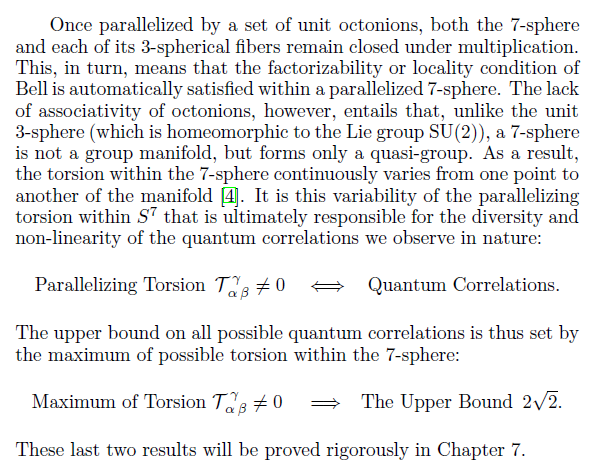
But of course they are the same, because the strong correlations have nothing much to do with quantum mechanics. They are a property of the geometry and topology of the physical space, S^3, as proved in considerable detail in the Chapter 7 of my book. Let me reproduce here a concluding passage from the Chapter 1 of the book:
***
PS1: Bell's trivial mistake (or the continued deception by his followers) is also discussed in elementary terms in this thread: viewtopic.php?f=6&t=267&p=6566#p6566.
PS2: Note also that the PRL paper seems to express surprise over their "discovery" that various upper bounds on the strong correlations are the same in classical physics.
But of course they are the same, because the strong correlations have nothing much to do with quantum mechanics. They are a property of the geometry and topology of the physical space, S^3, as proved in considerable detail in the Chapter 7 of my book. Let me reproduce here a concluding passage from the Chapter 1 of the book:
***
- Joy Christian
- Research Physicist
- Posts: 2793
- Joined: Wed Feb 05, 2014 4:49 am
- Location: Oxford, United Kingdom
Re: More classical experiments "violate" Bell inequalities:
by Joy Christian » Sat Jul 02, 2016 10:33 am
Guest wrote:I wouldn't get too excited by the Frustaglia et al. paper. The models presented are all manifestly nonlocal, because the outcome information is transmitted to the following measurement station. It is already well-known that nonlocal classical models can violate CH/CHSH.
Thank you, "Guest", for stating the obvious. But if I were you I would read their paper more carefully. What interests me in the paper is not the violation of outcome independence (I am sure you know what that means), but the fact that the upper bounds on correlations are respected also within purely classical set up (cf. my post).
***
- Joy Christian
- Research Physicist
- Posts: 2793
- Joined: Wed Feb 05, 2014 4:49 am
- Location: Oxford, United Kingdom
Re: More classical experiments "violate" Bell inequalities:
by FrediFizzx » Sat Jul 02, 2016 10:46 am
Guest AKA Don Graft wrote:I wouldn't get too excited by the Frustaglia et al. paper. The models presented are all manifestly nonlocal, because the outcome information is transmitted to the following measurement station. It is already well-known that nonlocal classical models can violate CH/CHSH.
From the paper, "However, Bell-inequality experiments can be
formally mapped into experiments involving sequential
measurements by replacing spacelike separation with
compatibility. In this way, any Bell-inequality experiment
[see Fig. 1(a)] is just a sequential contextuality
experiment [see Fig. 1(b)] in a certain reference frame."
- FrediFizzx
- Independent Physics Researcher
- Posts: 2905
- Joined: Tue Mar 19, 2013 7:12 pm
- Location: N. California, USA
Re: More classical experiments "violate" Bell inequalities:
by Joy Christian » Sat Jul 02, 2016 11:18 am
FrediFizzx wrote:Guest AKA Don Graft wrote:I wouldn't get too excited by the Frustaglia et al. paper. The models presented are all manifestly nonlocal, because the outcome information is transmitted to the following measurement station. It is already well-known that nonlocal classical models can violate CH/CHSH.
From the paper, "However, Bell-inequality experiments can be
formally mapped into experiments involving sequential
measurements by replacing spacelike separation with
compatibility. In this way, any Bell-inequality experiment
[see Fig. 1(a)] is just a sequential contextuality
experiment [see Fig. 1(b)] in a certain reference frame."

I suspected this was Don Graft. As you may have noticed, Graft, Gill and Schmelzer continue to make mind-numbingly stupid claims about my local model. How extraordinarily incompetent and ignorant they have to be to be making such stupid claims, even after we have explained their mistakes to them for many years?
And these people claim to have PhD's.

PS: In Gill's case, he hasn't yet read my refutation of his ridiculous arguments which is available on the arXiv since March 2012: http://arxiv.org/abs/1203.2529.
***
Last edited by Joy Christian on Sat Jul 02, 2016 12:37 pm, edited 2 times in total.
- Joy Christian
- Research Physicist
- Posts: 2793
- Joined: Wed Feb 05, 2014 4:49 am
- Location: Oxford, United Kingdom
Re: More classical experiments "violate" Bell inequalities:
by FrediFizzx » Sat Jul 02, 2016 11:29 am
Don Graft in another forum wrote:It's much worse than that. The Christian followers totally misinterpret the point of the paper. The models presented are manifestly nonlocal because the outcome information is passed to the subsequent measurements. It is of course well-known that nonlocal classical models can violate CH/CHSH. The intent of the paper was to discuss the nature of the bounds, not to show that there exists a local, classical model for CH/CHSH violation.
In any case, these people seem conflicted. They keep saying that nothing can violate the inequality and then favorably cite models that claim to do so, including Christian's own thought experiment. When one can accept math that allows to prove 1 = 2, I suppose this is no surprise. One can only be amused at the degree of hysteria and hyperbole that Christian is now displaying at his forum on the basis of this misinterpreted paper.
***
Of course Don doesn't understand the paper at all (see my previous post). Nor does he understand the "violation" aspect. I doubt that he will ever understand it. Bell's inequalities have never been violated. It is mathematically impossible. That is why Joy put quotes around violate in the title. We use the term "violate" in the same context as when people say QM "violates" Bell. It is sloppy language but is probably too engrained in the literature to get rid of it.
- FrediFizzx
- Independent Physics Researcher
- Posts: 2905
- Joined: Tue Mar 19, 2013 7:12 pm
- Location: N. California, USA
Re: More classical experiments "violate" Bell inequalities:
by FrediFizzx » Sat Jul 02, 2016 12:35 pm
Joy Christian wrote:I suspected this was Don Graft. As you may have noticed, Graft, Gill and Schmelzer continue to make mind-numbingly stupid claims about my local model. How extraordinarily incompetent and ignorant they have to be to be making such stupid claims, even after we have explained their mistakes to them for many years?
***
Yeah, there Is no doubt now that Graft is a Bell believer (Michel take note). But I also suspect he believes the predictions of QM to be wrong. One more strike and he is out.
Oh, his wrong papers is strike three. He's out. 
Now he has grasped onto Schmelzer's stupid 1 = 2 thing. Why do you think it is that these people can't do simple math? Even after I explained what they were doing wrong? It has to be pure dishonesty.
- FrediFizzx
- Independent Physics Researcher
- Posts: 2905
- Joined: Tue Mar 19, 2013 7:12 pm
- Location: N. California, USA
Re: More classical experiments "violate" Bell inequalities:
by FrediFizzx » Sat Jul 02, 2016 12:47 pm
Now Graft writes at the other forum, "We've all read the paper, Fred. What is your point? Did you notice that the outcomes are passed to the subsequent measurements, making the models nonlocal?
Meanwhile, over at your forum, insults, ad hominems, and bullying substitute for logic. You should be ashamed."
He still doesn't understand the experiment. We are not going to hold his hand and try to explain it to him. We try not to argue with idiots.
And I wonder why he thinks pure blatant dishonesty should be treated with any respect? You are a liar, Graft. Pure and simple. Your papers are junk physics just like Bell's theory. And you are too much of a coward to post here under your real name.
***
Meanwhile, over at your forum, insults, ad hominems, and bullying substitute for logic. You should be ashamed."
He still doesn't understand the experiment. We are not going to hold his hand and try to explain it to him. We try not to argue with idiots.
And I wonder why he thinks pure blatant dishonesty should be treated with any respect? You are a liar, Graft. Pure and simple. Your papers are junk physics just like Bell's theory. And you are too much of a coward to post here under your real name.
***
- FrediFizzx
- Independent Physics Researcher
- Posts: 2905
- Joined: Tue Mar 19, 2013 7:12 pm
- Location: N. California, USA
Re: More classical experiments "violate" Bell inequalities:
by Joy Christian » Sat Jul 02, 2016 7:43 pm
FrediFizzx wrote:
[Graft] still doesn't understand the experiment. We are not going to hold his hand and try to explain it to him. We try not to argue with idiots.
And I wonder why he thinks pure dishonesty should be treated with any respect?
Not just Graft, as we know, none of the Bell-believers, such as Gill or Schmelzer, understand elementary mathematics. Let me try one more time to explain:
Bell's (or rather Boole's) inequality is extremely easy to derive. For A = +/-1 and B = +/-1, the average
| E( a, b, a', b' ) | = | << A(a)B(b) + A(a)B(b' ) + A(a' )B(b) - A(a' )B'(b' ) >> | = | << A(a) [ B(b) + B(b' ) ] + A(a' ) [ B(b) - B(b' ) ] >> | = 2, or less than 2.
To begin with, this inequality has nothing whatsoever to do with any kind of physics; classical, quantum, or post-quantum. It is a total Mickey Mouse. A made up junk.
Now all Bell-believers like Graft, Gill and Schmelzer (not to mention Aaronson) believe that something actually violates the number 2 by some kind of voodoo.
We have asked them hundreds of times to demonstrate exactly how does the voodoo violate the number 2. We are still waiting for a numerical demonstration.
What actually happens is that all Bell-believers, including those in control of the peer-reviewed journals, cheat. They switch to an entirely different inequality.
This one:
| E(a, b) + E(a, b' ) + E(a', b) - E(a', b' ) | = 4, or less than 4,
which is also very easy to derive (see, for example, http://libertesphilosophica.info/blog/w ... /Fatal.pdf).
So by surreptitiously switching to this second inequality with the bound of 4, the Bell-believers claim that, aha, the first inequality with the bound of 2 is "violated."
They all cheat. Some of the cheaters are cleverer than others, but if you look carefully under their table you will eventually find Uri Geller hiding there somewhere.
***
- Joy Christian
- Research Physicist
- Posts: 2793
- Joined: Wed Feb 05, 2014 4:49 am
- Location: Oxford, United Kingdom
Re: More classical experiments "violate" Bell inequalities:
by FrediFizzx » Sat Jul 02, 2016 11:25 pm
Joy Christian wrote:They all cheat. Some of the cheaters are cleverer than others, but if you look carefully under their table you will eventually find Uri Geller hiding there somewhere.
***
And I can't believe they are actually that stupid with the math so the only logical conclusion is that they are all pathological liars. I should have taken a clue from Michel. He refused to discuss anything with Schmelzer on these forums since he recognized the fact of how dishonest he is.
- FrediFizzx
- Independent Physics Researcher
- Posts: 2905
- Joined: Tue Mar 19, 2013 7:12 pm
- Location: N. California, USA
Re: More classical experiments "violate" Bell inequalities:
by Dirkman » Sat Jul 02, 2016 11:56 pm
from physicsforums
"The paper didn't violate the Bell inequalities with a classical system. At least, not in the "we can pass Bell tests in real life" sense. Their pieces don't correspond to pieces from a Bell test, their pieces correspond to outcomes of a Bell test.
In the paper they say:
The classical equivalents to quantum states [that we use] are multichannel microwave signals propagating along independent waveguides with well-defined relative phases. Each classical microwave channel is identified with an element of the Hilbert space basis.
You know how, classically, three bits can be in the state 000, 001, 010, 011, 100, 101, 110, or 111 and so, quantumly, three qubits can be in any linear combination of those eight states? The authors didn't make a classical system with n (3) pieces, one for each qubit. They made a system with 2n (8) pieces, one for each basis state. Each basis state specifies all parts of the system, so their pieces are inherently non-local w.r.t. the system they are supposed to represent.
(To apply a local operation within the simulated system, they need to make all eight pieces do something. Only making one piece do something would apply a non-local operation within the system.)
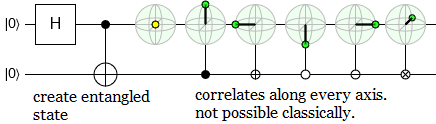
In other words, they made an esoteric simulator and then avoided just saying that directly in the summary. They didn't violate the Bell inequalities anymore than I did by using Quirk to make this : http://algorithmicassertions.com/quirk#circuit=%7B%22cols%22%3A%5B%5B%22H%22%5D%2C%5B%22%E2%80%A2%22%2C%22X%22%5D%2C%5B%22Bloch%22%5D%2C%5B%22Bloch%22%2C%22%E2%80%A2%22%5D%2C%5B%22Bloch%22%2C%22%E2%8A%95%22%5D%2C%5B%22Bloch%22%2C%22%E2%97%A6%22%5D%2C%5B%22Bloch%22%2C%22%E2%8A%96%22%5D%2C%5B%22Bloch%22%2C%22%E2%8A%97%22%5D%5D%7D
(Oh gosh, alert the presses! I s̶i̶m̶u̶l̶a̶t̶e̶d did something that's not possible classically!) "
"The paper didn't violate the Bell inequalities with a classical system. At least, not in the "we can pass Bell tests in real life" sense. Their pieces don't correspond to pieces from a Bell test, their pieces correspond to outcomes of a Bell test.
In the paper they say:
The classical equivalents to quantum states [that we use] are multichannel microwave signals propagating along independent waveguides with well-defined relative phases. Each classical microwave channel is identified with an element of the Hilbert space basis.
You know how, classically, three bits can be in the state 000, 001, 010, 011, 100, 101, 110, or 111 and so, quantumly, three qubits can be in any linear combination of those eight states? The authors didn't make a classical system with n (3) pieces, one for each qubit. They made a system with 2n (8) pieces, one for each basis state. Each basis state specifies all parts of the system, so their pieces are inherently non-local w.r.t. the system they are supposed to represent.
(To apply a local operation within the simulated system, they need to make all eight pieces do something. Only making one piece do something would apply a non-local operation within the system.)
In other words, they made an esoteric simulator and then avoided just saying that directly in the summary. They didn't violate the Bell inequalities anymore than I did by using Quirk to make this : http://algorithmicassertions.com/quirk#circuit=%7B%22cols%22%3A%5B%5B%22H%22%5D%2C%5B%22%E2%80%A2%22%2C%22X%22%5D%2C%5B%22Bloch%22%5D%2C%5B%22Bloch%22%2C%22%E2%80%A2%22%5D%2C%5B%22Bloch%22%2C%22%E2%8A%95%22%5D%2C%5B%22Bloch%22%2C%22%E2%97%A6%22%5D%2C%5B%22Bloch%22%2C%22%E2%8A%96%22%5D%2C%5B%22Bloch%22%2C%22%E2%8A%97%22%5D%5D%7D
(Oh gosh, alert the presses! I s̶i̶m̶u̶l̶a̶t̶e̶d did something that's not possible classically!) "
- Dirkman
- Posts: 24
- Joined: Sat Aug 22, 2015 9:39 pm
Re: More classical experiments "violate" Bell inequalities:
by FrediFizzx » Sun Jul 03, 2016 12:09 am
Dirkman wrote:from physicsforums
"The paper didn't violate the Bell inequalities with a classical system. At least, not in the "we can pass Bell tests in real life" sense. Their pieces don't correspond to pieces from a Bell test, their pieces correspond to outcomes of a Bell test. "
Oh for heaven's sake. Some other idiot that doesn't understand the experiment. I am sure glad that some referee at PRL did.
viewtopic.php?f=6&t=270&view=unread#p6597
- FrediFizzx
- Independent Physics Researcher
- Posts: 2905
- Joined: Tue Mar 19, 2013 7:12 pm
- Location: N. California, USA
Re: More classical experiments "violate" Bell inequalities:
by Joy Christian » Sun Jul 03, 2016 12:14 am
Dirkman wrote:from physicsforums
They didn't violate the Bell inequalities anymore than I did...
But of course they didn't. No one can violate bound of 2. It has nothing to do with physics, or this world (cf. my post above: viewtopic.php?f=6&t=270&p=6605#p6602).
***
- Joy Christian
- Research Physicist
- Posts: 2793
- Joined: Wed Feb 05, 2014 4:49 am
- Location: Oxford, United Kingdom
20 posts
• Page 1 of 1
Return to Sci.Physics.Foundations
Who is online
Users browsing this forum: No registered users and 135 guests