Between Joy Christian and Richard Gill: The middle way?

Foundations of physics and/or philosophy of physics, and in particular, posts on unresolved or controversial issues

Re: Between Joy Christian and Richard Gill: The middle way?

Postby gill1109 » Thu Sep 19, 2019 8:06 am

Joy Christian wrote:
gill1109 wrote:
Not only is Bell's inequality an elementary inequality which can be proven in a hundred different ways and is known under many different names, but the theorem that quantum mechanics is incompatible with local realism is an elementary theorem which also has many different proofs.

The first part of the above sentence is correct, but the second part in blue is false. There is no such theorem. And even if there was such a "theorem", there already exists a comprehensive local-realistic model for all quantum correlations. Therefore, the "theorem" would have been either irrelevant or wrong. So, please, stop the false propaganda.

Such a theorem has been stated and proved in a sufficiently mathematically rigorous fashion many times in the past, and moreover published in peer-reviewed journals of high reputation. See for instance Cator and Landsman (2014). https://www.math.ru.nl/~landsman/CatorLandsman.pdf Foundations of Physics, July 2014, Volume 44, Issue 7, pp 781–791 "Constraints on Determinism: Bell Versus Conway–Kochen". Calling this "propaganda" is not a very convincing argument.
gill1109
Mathematical Statistician
 
Posts: 2812
Joined: Tue Feb 04, 2014 10:39 pm
Location: Leiden

Re: Between Joy Christian and Richard Gill: The middle way?

Postby Joy Christian » Thu Sep 19, 2019 8:15 am

gill1109 wrote:
Joy Christian wrote:
gill1109 wrote:
Not only is Bell's inequality an elementary inequality which can be proven in a hundred different ways and is known under many different names, but the theorem that quantum mechanics is incompatible with local realism is an elementary theorem which also has many different proofs.

The first part of the above sentence is correct, but the second part in blue is false. There is no such theorem. And even if there was such a "theorem", there already exists a comprehensive local-realistic model for all quantum correlations. Therefore, the "theorem" would have been either irrelevant or wrong. So, please, stop the false propaganda.

Such a theorem has been stated and proved in a sufficiently mathematically rigorous fashion many times in the past, and moreover published in peer-reviewed journals of high reputation. See for instance Cator and Landsman (2014). https://www.math.ru.nl/~landsman/CatorLandsman.pdf Foundations of Physics, July 2014, Volume 44, Issue 7, pp 781–791 "Constraints on Determinism: Bell Versus Conway–Kochen". Calling this "propaganda" is not a very convincing argument.

The first two words in the abstract of the linked paper are: "Bell’s Theorem." But there is no such "theorem." Some call it a "theorem" to mislead the gullible masses without expertise in the subject. The argument of the linked paper relies on this non-existent "theorem", and hence their argument is also wrong. Tell that to Landsman. We have known each other for a long time.

***
Joy Christian
Research Physicist
 
Posts: 2793
Joined: Wed Feb 05, 2014 4:49 am
Location: Oxford, United Kingdom

Re: Between Joy Christian and Richard Gill: The middle way?

Postby gill1109 » Thu Sep 19, 2019 8:22 am

Joy Christian wrote:
gill1109 wrote:
Joy Christian wrote:
gill1109 wrote:
Not only is Bell's inequality an elementary inequality which can be proven in a hundred different ways and is known under many different names, but the theorem that quantum mechanics is incompatible with local realism is an elementary theorem which also has many different proofs.

The first part of the above sentence is correct, but the second part in blue is false. There is no such theorem. And even if there was such a "theorem", there already exists a comprehensive local-realistic model for all quantum correlations. Therefore, the "theorem" would have been either irrelevant or wrong. So, please, stop the false propaganda.

Such a theorem has been stated and proved in a sufficiently mathematically rigorous fashion many times in the past, and moreover published in peer-reviewed journals of high reputation. See for instance Cator and Landsman (2014). https://www.math.ru.nl/~landsman/CatorLandsman.pdf Foundations of Physics, July 2014, Volume 44, Issue 7, pp 781–791 "Constraints on Determinism: Bell Versus Conway–Kochen". Calling this "propaganda" is not a very convincing argument.

The first two words in the abstract of the linked paper are: "Bell’s Theorem." But there is no such "theorem." Some call it a "theorem" to mislead the gullible masses without expertise in the subject. The argument of the linked paper relies on this non-existent "theorem", and hence their argument is also wrong. Tell that to Landsman. We have known each other for a long time.

The paper contains theorems and proofs. Read them. A formal version of "Bell's theorem" (incompatibility of QM and local realism) is in there, too. You are trying to mislead gullible masses without expertise in the subject and without expertise in the necessary parts of mathematics.
gill1109
Mathematical Statistician
 
Posts: 2812
Joined: Tue Feb 04, 2014 10:39 pm
Location: Leiden

Re: Between Joy Christian and Richard Gill: The middle way?

Postby Joy Christian » Thu Sep 19, 2019 8:28 am

gill1109 wrote:
A formal version of "Bell's theorem" (incompatibility of QM and local realism) is in there, too.

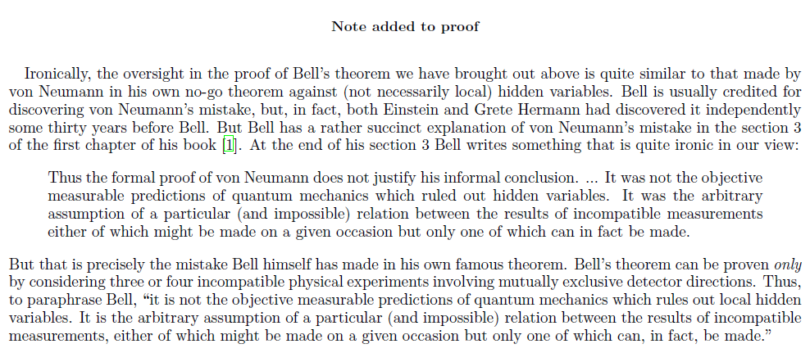
There cannot be a formal version of a non-existent "theorem." Bell himself has quite aptly pointed out the problem with his so-called theorem. Let me point that out again for your benefit:

Image

What is more, Bell inequalities can be derived by assuming only the incompatibility of three or four experiments: https://arxiv.org/pdf/1704.02876.pdf.

***
Joy Christian
Research Physicist
 
Posts: 2793
Joined: Wed Feb 05, 2014 4:49 am
Location: Oxford, United Kingdom

Re: Between Joy Christian and Richard Gill: The middle way?

Postby gill1109 » Thu Sep 19, 2019 8:44 am

Heinera wrote:
Gordon Watson wrote:.
It might help us all if you could each provide your definition of an RV. And in the context of Bell's work, if you think it there differs from the definition used in probability and statistics.

PS: I use λ in FUNCTIONS: eg, A(a,λ).

Thanks; Gordon
.

There is already a thread for that topic, and to be honest I don't see that there has been any resolution of the matter in that thread.

But Bell's argument goes through even without the assumption that lambda is a random variable, so I agree with you that there is not much point in explicitly assuming it is random in the context of Bell's theorem.

In Bell's argument, lambda is an element of a set Lambda, and the probability that it lies in any particular subset of Lambda is the integral over that subset of rho(lambda) d lambda. We think of nature picking a value lambda at random from the set Lambda. After that, everything is deterministic. If the experimenter has chosen to use setting a in Alice's wing of the experiment and b in Bob's, then the outcomes they get to see are A(a, lambda) and B(b, lambda). A and B are fixed functions which take values +/-1.

One can rewrite and generalise this in the language of conventional probability theory. Just rename lambda as omega, Lambda as Omega. Let A_a be the random variable (a function of omega) A(a, . ), taking values in +/-1. Instead of assuming a probability density rho we would assume a probability measure P. Instead of writing integral ... rho(lambda) d lambda we would write integral ... d P(omega). We could also drop the "omega" everywhere and write E(A_a B_b) or if you prefer integral_Omega (A_a B_b) d P instead of integral .... rho(lambda) d lambda. The usual rules stay valid. The same proof goes through. It's completely elementary.

Christian's original idea was that he would let A_a and B_b take values in a different larger space, but one which does still contain elements called -1 and +1, satisfying the usual rules, and actually A_a and B_b did only take those two particular values. This cannot change anything! The reason he got a result violating Bell's inequality was by hiding a sign error in his geometric algebra, where nobody would see it, because almost nobody knows enough geometric algebra to check the details. But of course that was unnecessary.

Later he decided to use other and more complicated tricks. You could say there was Christian 1.0, then Christian 2.0, and finally Christian 3.0.

Last edited by gill1109 on Thu Sep 19, 2019 9:19 am, edited 1 time in total.
gill1109
Mathematical Statistician
 
Posts: 2812
Joined: Tue Feb 04, 2014 10:39 pm
Location: Leiden

Re: Between Joy Christian and Richard Gill: The middle way?

Postby Heinera » Thu Sep 19, 2019 9:16 am

gill1109 wrote: We think of nature picking a value lambda at random from the set Lambda.

Doesn't have to be nature. It could be a gnome. Bell's theorem would still be true.
Heinera
 
Posts: 917
Joined: Thu Feb 06, 2014 1:50 am

Re: Between Joy Christian and Richard Gill: The middle way?

Postby gill1109 » Thu Sep 19, 2019 9:20 am

Heinera wrote:
gill1109 wrote: We think of nature picking a value lambda at random from the set Lambda.

Doesn't have to be nature. It could be a gnome. Bell's theorem would still be true.

Sure, it could be a gnome. But in the context of Bell's theorem we think of it as "nature".
gill1109
Mathematical Statistician
 
Posts: 2812
Joined: Tue Feb 04, 2014 10:39 pm
Location: Leiden

Re: Between Joy Christian and Richard Gill: The middle way?

Postby Joy Christian » Thu Sep 19, 2019 9:32 am

gill1109 wrote:
Christian's original idea was that he would let A_a and B_b take values in a different larger space, but one which does still contain elements called -1 and +1, satisfying the usual rules, and actually A_a and B_b did only take those two particular values. This cannot change anything! The reason he got a result violating Bell's inequality was by hiding a sign error in his geometric algebra, where nobody would see it, because almost nobody knows enough geometric algebra to check the details. But of course that was unnecessary.

Later he decided to use other and more complicated tricks. You could say there was Christian 1.0, then Christian 2.0, and finally Christian 3.0.

These are all completely false claims, in their entirety. You actually have no clue what you are talking about when it comes to my 3-sphere model. So stop pretending that you have a clue.

***
Joy Christian
Research Physicist
 
Posts: 2793
Joined: Wed Feb 05, 2014 4:49 am
Location: Oxford, United Kingdom

Re: Between Joy Christian and Richard Gill: The middle way?

Postby FrediFizzx » Thu Sep 19, 2019 10:22 am

Joy Christian wrote:
gill1109 wrote:
Christian's original idea was that he would let A_a and B_b take values in a different larger space, but one which does still contain elements called -1 and +1, satisfying the usual rules, and actually A_a and B_b did only take those two particular values. This cannot change anything! The reason he got a result violating Bell's inequality was by hiding a sign error in his geometric algebra, where nobody would see it, because almost nobody knows enough geometric algebra to check the details. But of course that was unnecessary.

Later he decided to use other and more complicated tricks. You could say there was Christian 1.0, then Christian 2.0, and finally Christian 3.0.
These are all completely false claims, in their entirety. You actually have no clue what you are talking about when it comes to my 3-sphere model. So stop pretending that you have a clue.

***

Yeah, we have demonstrated here on the forum a bunch of ways to Sunday that there is no sign error so I don't know why he keeps harping on that.
.
FrediFizzx
Independent Physics Researcher
 
Posts: 2905
Joined: Tue Mar 19, 2013 7:12 pm
Location: N. California, USA

Re: Between Joy Christian and Richard Gill: The middle way?

Postby Gordon Watson » Thu Sep 19, 2019 1:53 pm

Heinera wrote:
Gordon Watson wrote:However, please note that (2) [sic] is the quickest way, imho, to spot your error. Since, when you think about it: no Bell-valid function [trivial or not] can eliminate that error.
.

The only requirement (your "Bell-valid") Bell sets on his function A is that it should take one of two values, +1 or -1. Which one of them depends on the values of the two input parameters. Any function that satisfies this is OK as far as Bell's theorem is concerned.

For instance, as an example in the paper Bell uses . This does not make your integral (2) equal to 0, and is thus a counterexample to your claim.


I thought you and I were in agreement that λ was a random physical variable? A continuous random beable, in Bell's terms?

So what value did you get when you completed the integration of ?

Thanks.
Gordon Watson
 
Posts: 403
Joined: Wed Apr 30, 2014 4:39 am

Re: Between Joy Christian and Richard Gill: The middle way?

Postby Gordon Watson » Thu Sep 19, 2019 2:39 pm

Heinera wrote:Anyone who start their argument against Bell's theorem with the experimental fact that each particle can only be measured once, with only one setting for the detector, can merely conclude that experimental data can violate Bell's inequality. Thank you, but we already knew that.


1. As we work toward resolving our differences, it might help if we be clear: What is your definition of Bell's theorem (BT)?

2. Here's mine: BT is Bell's false impossibility claim beneath Bell(3). It's what I call BE2 (Bell's second error).

3. In case it helps, here's how I started my argument against Bell.

Correlated spacelike-separated tests [CT = cos(a,b)] on correlated separated particles [CP: λ' = -λ'', each being a sensitive beable] produce correlated results [CR: E(a b) = -cos(a,b)] without mystery.

There's the cosine, there's the minus sign, there's the answer: where's the mystery? All under TLR (true local realism):

TLR being my way of delivering what Bell expected would be delivered: proof that relativity and QM are compatible; that his total confusion re AAD would one-day be resolved; see my essay. (At ¶4.2 in v1.)
.
Gordon Watson
 
Posts: 403
Joined: Wed Apr 30, 2014 4:39 am

Re: Between Joy Christian and Richard Gill: The middle way?

Postby FrediFizzx » Thu Sep 19, 2019 7:10 pm

gill1109 wrote:
FrediFizzx wrote:Yeah, I don't know why Gordon keeps harping about some error in the derivation of the inequality. There is no error in the inequality itself as it is mathematically proven. The error arises when you say a, b and c can happen all at the same time. They can't. It is that simple.
.

Indeed, the inequality is trivial.

But nobody says that a, b and c "happen" at the same time. a, b and c are the names of three unit vectors. Alice and Bob are experimenters who may choose which of these three vectors to use as a setting in each of their apparatus. In any one trial of the series of experiments, Alice chooses one of the three, and Bob chooses one of the three.

Try to show that QM "violates" the inequality without all three happening at the same time.
.
FrediFizzx
Independent Physics Researcher
 
Posts: 2905
Joined: Tue Mar 19, 2013 7:12 pm
Location: N. California, USA

Re: Between Joy Christian and Richard Gill: The middle way?

Postby Gordon Watson » Thu Sep 19, 2019 9:30 pm

Gordon Watson wrote:
Heinera wrote:
Gordon Watson wrote:However, please note that (2) [sic] is the quickest way, imho, to spot your error. Since, when you think about it: no Bell-valid function [trivial or not] can eliminate that error.
.

The only requirement (your "Bell-valid") Bell sets on his function A is that it should take one of two values, +1 or -1. Which one of them depends on the values of the two input parameters. Any function that satisfies this is OK as far as Bell's theorem is concerned.

For instance, as an example in the paper Bell uses . This does not make your integral (2) equal to 0, and is thus a counterexample to your claim.


I thought you and I were in agreement that λ was a random physical variable? A continuous random beable, in Bell's terms?

So what value did you get when you completed the integration of ?

Thanks.


Dear Heinera,

My math won't carry the day here. I thought it was a valid shortcut, it's not. I'll bring your set of equations down and continue my case from there.
Gordon Watson
 
Posts: 403
Joined: Wed Apr 30, 2014 4:39 am

Re: Between Joy Christian and Richard Gill: The middle way?

Postby gill1109 » Fri Sep 20, 2019 2:19 am

FrediFizzx wrote:
gill1109 wrote:
FrediFizzx wrote:Yeah, I don't know why Gordon keeps harping about some error in the derivation of the inequality. There is no error in the inequality itself as it is mathematically proven. The error arises when you say a, b and c can happen all at the same time. They can't. It is that simple.
.

Indeed, the inequality is trivial.

But nobody says that a, b and c "happen" at the same time. a, b and c are the names of three unit vectors. Alice and Bob are experimenters who may choose which of these three vectors to use as a setting in each of their apparatus. In any one trial of the series of experiments, Alice chooses one of the three, and Bob chooses one of the three.

Try to show that QM "violates" the inequality without all three happening at the same time.
.

I repeat: NOBODY assumes all three "happen" at the same time. Joy Christian created a straw man in order to fight Bell. Joy's straw puppet creation shows that despite himself (Joy) listening at the master's feet, he has no idea what the master was on about.

Unit vectors don't "happen". In a Bell type experiment, one or two or none of them might be *chosen* as settings at the same time.

Sorry Fred, I think you (and some others here) have no idea at all what we are talking about.

Sorry, I know very well that you (and some others here) think and say the same about me. That's OK by me, as long as we stay civilized.

We can still be friends, I hope.
gill1109
Mathematical Statistician
 
Posts: 2812
Joined: Tue Feb 04, 2014 10:39 pm
Location: Leiden

Re: Between Joy Christian and Richard Gill: The middle way?

Postby Joy Christian » Fri Sep 20, 2019 6:17 am

gill1109 wrote:
FrediFizzx wrote:
gill1109 wrote:
FrediFizzx wrote:Yeah, I don't know why Gordon keeps harping about some error in the derivation of the inequality. There is no error in the inequality itself as it is mathematically proven. The error arises when you say a, b and c can happen all at the same time. They can't. It is that simple.
.

Indeed, the inequality is trivial.

But nobody says that a, b and c "happen" at the same time. a, b and c are the names of three unit vectors. Alice and Bob are experimenters who may choose which of these three vectors to use as a setting in each of their apparatus. In any one trial of the series of experiments, Alice chooses one of the three, and Bob chooses one of the three.

Try to show that QM "violates" the inequality without all three happening at the same time.
.

I repeat: NOBODY assumes all three "happen" at the same time. Joy Christian created a straw man in order to fight Bell. Joy's straw puppet creation shows that despite himself (Joy) listening at the master's feet, he has no idea what the master was on about.

Unit vectors don't "happen". In a Bell type experiment, one or two or none of them might be *chosen* as settings at the same time.

Sorry Fred, I think you (and some others here) have no idea at all what we are talking about.

Sorry, I know very well that you (and some others here) think and say the same about me. That's OK by me, as long as we stay civilized.

We can still be friends, I hope.

We know perfectly well what you are talking about. You are talking rubbish. Have you read my paper I linked elsewhere? Please read your master's words in my paper linked below:
Joy Christian wrote:
Image

What is more, Bell inequalities can be derived by assuming only the incompatibility of three or four experiments: https://arxiv.org/pdf/1704.02876.pdf.
Joy Christian
Research Physicist
 
Posts: 2793
Joined: Wed Feb 05, 2014 4:49 am
Location: Oxford, United Kingdom

Re: Between Joy Christian and Richard Gill: The middle way?

Postby gill1109 » Fri Sep 20, 2019 8:10 am

Joy Christian wrote:We know perfectly well what you are talking about. You are talking rubbish. Have you read my paper I linked elsewhere? Please read your master's words in my paper linked below:
Image

I know those words well, and on this point agree with Bell.

I am my own master.
gill1109
Mathematical Statistician
 
Posts: 2812
Joined: Tue Feb 04, 2014 10:39 pm
Location: Leiden

Re: Between Joy Christian and Richard Gill: The middle way?

Postby Joy Christian » Fri Sep 20, 2019 8:15 am

gill1109 wrote:
I know those words well, and on this point agree with Bell.

Alas, his words have gone in your one ear and immediately come out from another. :-(

***
Joy Christian
Research Physicist
 
Posts: 2793
Joined: Wed Feb 05, 2014 4:49 am
Location: Oxford, United Kingdom

Re: Between Joy Christian and Richard Gill: The middle way?

Postby FrediFizzx » Fri Sep 20, 2019 8:28 am

gill1109 wrote:
FrediFizzx wrote:
gill1109 wrote:
FrediFizzx wrote:Yeah, I don't know why Gordon keeps harping about some error in the derivation of the inequality. There is no error in the inequality itself as it is mathematically proven. The error arises when you say a, b and c can happen all at the same time. They can't. It is that simple.
.

Indeed, the inequality is trivial.

But nobody says that a, b and c "happen" at the same time. a, b and c are the names of three unit vectors. Alice and Bob are experimenters who may choose which of these three vectors to use as a setting in each of their apparatus. In any one trial of the series of experiments, Alice chooses one of the three, and Bob chooses one of the three.

Try to show that QM "violates" the inequality without all three happening at the same time.
.

I repeat: NOBODY assumes all three "happen" at the same time. Joy Christian created a straw man in order to fight Bell. Joy's straw puppet creation shows that despite himself (Joy) listening at the master's feet, he has no idea what the master was on about.

Unit vectors don't "happen". In a Bell type experiment, one or two or none of them might be *chosen* as settings at the same time. ...

Joy didn't create anything. Not sure why you are mentioning him as I was doing this before Joy wrote his paper about it. I didn't think you would be able to demonstrate how QM "violates" the inequality without all three happening at the same time. You can't because it is mathematically impossible for anything to violate the inequality. You can have a and b or b and c or a and c so you can't even do the inequality without putting in some fictitious quantity for the 3rd man out.
.
FrediFizzx
Independent Physics Researcher
 
Posts: 2905
Joined: Tue Mar 19, 2013 7:12 pm
Location: N. California, USA

Re: Between Joy Christian and Richard Gill: The middle way?

Postby Heinera » Fri Sep 20, 2019 9:11 am

FrediFizzx wrote: I didn't think you would be able to demonstrate how QM "violates" the inequality without all three happening at the same time.
.

Can you show us exactly where in the paper Bell (1964) he makes the assumption (explicit or implicit) that all three must happen at the same time?
Heinera
 
Posts: 917
Joined: Thu Feb 06, 2014 1:50 am

Re: Between Joy Christian and Richard Gill: The middle way?

Postby FrediFizzx » Fri Sep 20, 2019 9:39 am

Heinera wrote:
FrediFizzx wrote: I didn't think you would be able to demonstrate how QM "violates" the inequality without all three happening at the same time.
.

Can you show us exactly where in the paper Bell (1964) he makes the assumption (explicit or implicit) that all three must happen at the same time?

I didn't think you could do it either. Instead you deflect the question. It is quite obvious that for the inequality to be physically true, all three must happen at the same time.
.
FrediFizzx
Independent Physics Researcher
 
Posts: 2905
Joined: Tue Mar 19, 2013 7:12 pm
Location: N. California, USA

PreviousNext

Return to Sci.Physics.Foundations

Who is online

Users browsing this forum: No registered users and 124 guests

CodeCogs - An Open Source Scientific Library